REVIEW – White Dog (1982)

WhiteDogFilmJuice have my review of the recent Masters of Cinema release of Samuel Fuller’s racially-themed horror film White Dog.

Cutting to the chase, I really enjoyed this film. Set on the margins of Hollywood, the film tells of an actress who happens to run over a beautiful white Alsatian dog. Forced to take responsibility to the animal after taking it to the vet, the actress nurses it back to health and has all of her care and attention redeemed when the animal protects her from a rapist who breaks into her home. Fuller shoots the dog at night using spotlights that reflect against the whiteness of the fur but not the background meaning that the dog appears to glow in an almost spectral fashion. The otherwordliness of the dog is put to brilliant use when it escapes the actress’s yard and begins attacking black people: The pure white dog devouring black people and covering itself in blood is as striking and troubling an image of racism as you could possibly imagine. Part of what makes these images so troubling is the fact that they could just as easily have been inserted into a film about a heroic white dog that eats evil black people. However, to look upon these scenes as racist or problematic is to ignore the wider context of the film and how the film is really about trying to cure racism:

Fuller intends the dog (tellingly referred to as ‘Mr Hyde’) to serve as a metaphorical representation of human racism and, to a certain extent, he does: One point the film repeatedly makes is that there is nothing ‘natural’ about the dog’s hatred of black people; his fear and hatred were deliberately engineered by people who wanted to use his savagery as a tool of racial segregation and oppression. Another point the film makes is that the techniques required to train a racist dog were pioneered in the days of slavery when plantation owners had a vested interest in keeping vicious attack dogs that would happily kill a black person but never think to harm a white person. These two ideas certainly mesh with contemporary thoughts on social justice and they make a very interesting point about how the racist attitudes that continue to be perpetuated today originated in a time when extreme and dehumanising patterns of racist thought underpinned an entire economic system. Fuller’s metaphorical racist dog also represents how difficult it can be to wean oneself away from racist thought and how some attitudes can be so deeply engrained that unravelling them is tantamount to unravelling an entire personality. However, Fuller’s metaphor only goes so far.

While I think that Fuller’s position is somewhat outdated (one of the first things you learn about social justice is that it’s a white person’s duty to educate themselves and not to be ‘saved’ by black and minority ethnic people) I don’t think it’s racist. In fact, I think that White Dog is a thoughtful and intellectually intense film that tries to grapple with a huge and incredibly different problem. What I don’t understand is the logic of using an intensely problematic piece of fiction as a springboard for that engagement.

White Dog is based on a book by the French novelist Romain Gary which tells the semi-autobiographical story of a dog who has been trained to attack black people on sight. As in the film, a black animal trainer steps in and tries to cure the animal but rather than getting rid of the animal’s murderous urges entirely, the trainer simply reprograms the animal to attack white people instead. As I explain in the review, Gary intended this as a critique of civil rights activists who, in his opinion, were training people to be ‘intolerant of intolerance’. From J. Hoberman’s interesting piece about the film:

Gary and his then wife, actress Jean Seberg, find a stray German shepherd that, they soon discover, has been raised to attack black people on sight. Although told that the dog is too old to be deconditioned, they turn him over to an animal trainer who turns out to be a Black Muslim and vengefully reprograms the creature to maul whites—including, at the book’s climax, Gary himself. (Some of the vengeance in this “found” allegory belongs to the author: Gary disapproved of his wife’s public support of the Black Panther Party, a political stance that put her under FBI investigation.)

This attempt to set up an equivalence between systemic white racism and angry reaction to that racist system will be familiar to anyone who remembers the much-lamented Derailing For Dummies site as the ‘You’re As Bad as They Are!’ defence:

Because they’re angry about the treatment they undergo and because they are aggressive and persistent in wanting to see change happen, you can target this behaviour (remembering that it is unseemly for Marginalised People™ – they’re supposed to set an example at all times by being humble and long suffering) by suggesting it puts them on a par with the people and system that stigmatise, ostracise and target them every second of every day of their lives. This also suggests that reacting to such discrimination is totally unreasonable and out of proportion (they should just take their knocks!) and that has the benefit of indicating your ignorance to just how pervasive and constant this discrimination truly is.

Thankfully, Fuller does not follow Gary down that particular political rabbit hole but it I can’t imagine anyone wanting to base a contemporary critique of racism on a book that suggests black civil rights activists are morally equivalent to people who train their animals to attack black people on sight.


REVIEW – Phantom of the Paradise (1974)

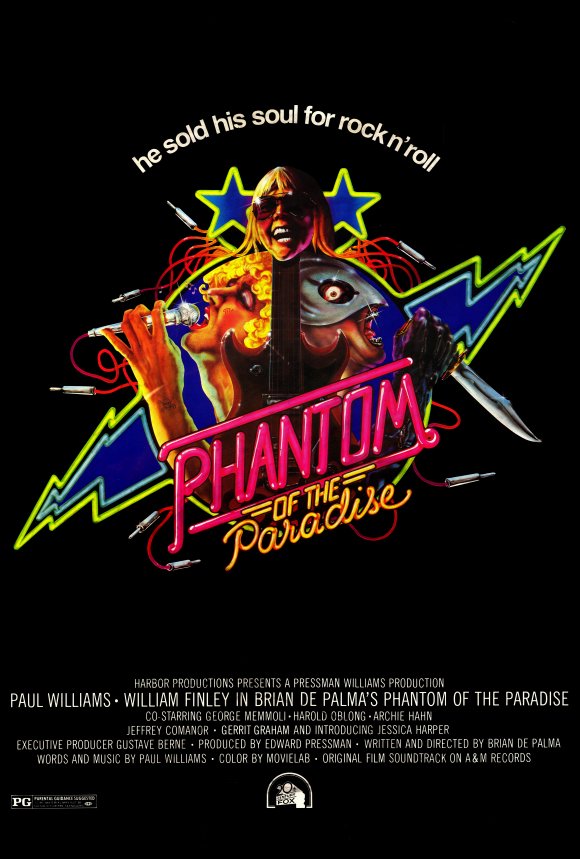
phantom posterFilmJuice have my review of Brian De Palma’s rock opera Phantom of the Paradise. I was not impressed.

Made in the coke-bloat years of prog rock, this musical mashes up Faust and Phantom of the Opera to produce a weirdy-beardy story about a composer who is lured into cooperating with a sinister record producer only for the sinister record producer to betray him, steal his music, get him thrown in jail and eventually try to wall him up in a room in his enormous house. Visually, the film is extraordinary as De Palma makes great use of then-emerging video editing technologies to produce all kinds of split-screen and other effects. My problem was with every other aspect of the film:

Originally a dutiful student of the French New Wave, Brian De Palma soon migrated towards populist films with a hint of artificiality: Carrie and The Fury mused over psychic powers while thrillers such as Body Double and Dressed to Kill obsessed over the appearance of female bodies before hacking them to pieces. Best known for his gangster epics Scarface, The Untouchables and Carlito’s Way, De Palma instinctively understood the swaggering pretence of the American hoodlum and how sharp suits and theatrical yelling are a neat way of masking a predator’s scent. Indeed, no film better encapsulates Brian De Palma’s strengths and weaknesses than his much-underrated reboot of the Mission: Impossible franchise: Expensive, slick and entirely populated by people pretending to be someone else, M:I is far more interested in the elegant imitation of humanity than humanity itself. True to form, De Palma’s early rock opera Phantom of the Paradise is obsessed with masks, illusions and pastiches but offers nothing in the way of emotional reality.

As a satire of the music industry, this is pretty toothless stuff not least because while De Palma is quick to point fingers at the excesses of the prog rock era, his proposed solution to the excess is an operatic rock ‘cantata’ based on the legend of Faust. As I said in my review, this is precisely the kind of portentous rubbish that punk set out to destroy and it’s very difficult for a satire to function when the ‘disease’ and ‘cure’ seem equally bad.

The more pressing problem is that the music is almost entirely hideous. Written and mostly performed by the jowly-voiced Paul Williams (of Bugsy Malone fame) this supposed ‘rock opera’ is neither musically complex enough to be operatic nor raw enough to be rock. In effect, this is pompous music theatre with additional cod-pieces. The pastiches are mildly interesting as they do sound quite a bit like the bands they’re supposed to be pastiches of but the songs themselves are neither satirical nor particularly memorable meaning that this vicious attack on soulless nostalgia is itself nothing more an exercise in soulless nostalgia. Watching this, I couldn’t stop thinking about the Dead Kennedys’s “M.T.V. – Get off the air”.

This film has evidently acquired something of a cult following as the re-release comes with a selection of interviews and extras that seems wildly out of proportion with a flabby and emotionally hollow rock opera from the 1970s. However, as is often the case in these types of situations, the interviews unwittingly reveal quite a bit about the flaws in the production process as much like the Alan Partridge: Alpha Papa DVD revealed Steve Coogan’s willingness to work without a finished script and openly countermand the wishes of the director, the interviews included on the DVD reveal Paul Williams to be just as egomaniacal and unsettling as his onscreen counterpart.

REVIEW – Ender’s Game (2013)

endsgameVideovista has my review of Gavin Hood’s cinematic adaptation of Orson Scott Card’s sinister science fiction novel Ender’s Game.

Quite possibly the single most commercially successful science fiction novel of all time, Ender’s Game tells the story of a gifted child who is groomed, recruited and trained to become the military commander who will defend Earth against an imminent and unavoidable attack by a race of inscrutable ant-like aliens known as the Formics (the novel’s ambiguously homophobic term ‘buggers’ having been dropped from the film due to the negative press surrounding Card’s activities as an anti-LGBT spokesperson and activist). Having now watched the film and re-read the novel, I am struck by the fact that Ender’s Game sits rather uncomfortably between two different stools:

On the one hand, the story (originally published as a novella in Analog) is a throwback to the golden age of science fiction where genocidal space captains were not seen as particularly problematic characters. This aspect of the novel sits squarely in the foreground and is obvious from the fact that much of the novel’s enduring appeal lies in the fact that it is one enormous Geek power fantasy about a super-smart kid who beats the shit out of his bullies, gets all the cool friends and saves the day despite being misunderstood and persecuted.

On the other hand, the story is painfully aware of the literary turn of 1960s science fiction and so tries to reflect the fact that you can no longer get away with writing a novel about a genocidal space commander without acknowledging the fact that genocide is bad (Mm’kay?) and that characters need to be well-rounded individuals with internal conflicts to resolve. This aspect of the novel is evident not only in Ender’s undirected and largely uncritical angst but also in the way that the book tries to have its cake and eat it too by building towards a climactic battle only to then suggest that climactic battles aren’t necessarily a good idea.

The tension between these sets of literary values not only explains why the more recent Ender’s Shadow (a retelling of the book from the perspective of Ender’s psychopathic and entirely angst-free sidekick Bean) is a far superior novel, it also explains why Ender’s Game is such a deeply problematic work of fiction. Had Ender’s Game embraced its golden age roots and been about a heroic kiddy space captain then it would have been nothing more than your standard piece of reactionary escapist SF fluff and had Ender’s Game been about the morally problematic aspects of military service then it would have been a pretty good revisionist MilSF novel comparable to Joe Haldeman’s The Forever War. However, by trying to write within two politically incompatible literary traditions, Card effectively wound up creating a novel that emphasises all the worst aspects of traditional science fiction.

I don’t like the politics of Ender’s Game and I don’t like the politics of this film:

The problem is not that Ender’s Game is a power fantasy wrapped in a persecution complex and fired into the faces of unsuspecting children, the problem is that this film sends a message that the only rational and intelligent response to feelings of alienation, betrayal and confusion is to conform to the demands of the institutions that caused those negative feelings in the first place. Ender’s Game is not content with telling us that there is no alternative to a life of selfish brutality, it goes out of its way to present that life as sane, heroic and oh so very clever. Gavin Hood’s film is well made and elegant to look at, as beautiful as a $110 million advert for fascism could ever hope to be.

I’m not the first person to have this reaction:

  • Elaine Radford wrote an essay entitled “Ender and Hitler: Sympathy for the Superman” in which she points out a number of moral and biographical similarities between the two genocides.
  • John Kessel wrote an essay entitled “Creating the Innocent Killer: Ender’s Game, Intention and Morality” in which he points out the problematic nature of Card’s moral system.

But I don’t think I’ve seen anyone else point out that the book is not only fascistic but also incredibly derivative as it is essentially a re-skinning of Tom Godwin’s short story “The Cold Equations”. I outline the similarities between the two texts at some length in my review but the similarities are even more striking when you read the original “Ender’s Game” novelette, which was published in 1977 in the same magazine that originally published “The Cold Equations”.

PS Not long after uploading this, I came across a recent Cory Doctorow column from Locus magazine that essentially makes the exact same point about the artificiality of TINA and how Godwin creates a particular moral scenario and then expunges all blame and concepts of moral responsibility by willfully confusing the political laws governing the pilot’s society with the laws of nature. Given that it’s written by Cory Doctorow, the piece is significantly better written than mine and makes the connection I somehow missed with the concept of moral hazard:

The parameters of ‘‘The Cold Equations’’ are not the inescapable laws of physics. Zoom out beyond the page’s edges and you’ll find the author’s hands carefully arranging the scenery so that the plague, the world, the fuel, the girl and the pilot are all poised to inevitably lead to her execution. The author, not the girl, decided that there was no autopilot that could land the ship without the pilot. The author decided that the plague was fatal to all concerned, and that the vaccine needed to be delivered within a timeframe that could only be attained through the execution of the stowaway.

It is, then, a contrivance. A circumstance engineered for a justifiable murder. An elaborate shell game that makes the poor pilot – and the company he serves – into victims every bit as much as the dead girl is a victim, forced by circumstance and girlish naïveté to stain their souls with murder.

Moral hazard is the economist’s term for a rule that encourages people to behave badly. For example, a rule that says that you’re not liable for your factory’s pollution if you don’t know about it encourages factory owners to totally ignore their effluent pipes – it turns willful ignorance into a profitable strategy.

He then goes on to talk about the moral horrors of a Robert Heinlein story and I am reminded, yet again of that author’s toxic influence on the history of science fiction.

REVIEW – The Killers (1964)

The-Killers-Blu-rayFilmJuice have my review of Don Siegel’s The Killers, an awesome character-based crime thriller starring Lee Marvin, John Cassavetes and Ronald Reagan.

Based on a short story by Ernest Hemmingway and originally made for American television, The Killers poses the question as to why someone would refuse to run when confronted by two men who had been sent to kill him. Unlike the original short story (which is minimalist to the point of being nothing but negative conceptual space), Don Siegel’s adaptation functions as a kind of therapeutic process that buries into the past of a murder victim and tries to make sense of the decisions that lead him all the way to that refusal to run.

It is difficult to watch The Killers without becoming a tiny bit obsessed with Marvin’s performance. A former marine and infamous drunk, Marvin spent the 1960s carving out a reputation as a cinematic tough guy. What made him so special is that, unlike most of his contemporaries who depicted violence as an unpleasant but occasionally necessary part of a heroic vocation, Marvin let the spirit of violence seep into his bones and tried to depict it with as much realism as possible. Fifty years on and Marvin’s interrogation of the blind receptionist is still incredibly difficult to watch… it is too real and too unapologetically sadistic. Brilliantly, Siegel embraces the visceral character of the opening scene and uses it to set the tone for the entire film; The Killers is not just about hooking up with the wrong woman, it is also about the huge psychological cost of violence and how the threat of violence can grind you down, wear you out and drive you to acts of madness in a bid to escape. The solution to Hemmingway’s question is contained in the look of terror on that blind receptionist’s face.

In the few weeks since I wrote the review, the thing that has remained with me is the threat of violence. Most thrillers wear their violence and law-breaking on their sleeves and derive most of their tension from the idea that violence and law-breaking might be deployed unsuccessfully: Will the heist fail? Will the hero walk away from the gun-fight? The Killers is very different in this respect as all of the film’s tension comes from the threat of violence. Though much of this threat is down to the film’s astonishing opening sequence, I have now come to realise that Marvin’s presence in the film would not have been half as effective if it hadn’t been juxtaposed against that of the wonderfully nervy and unconstrained Cassavetes. Done up in pitch-black shades and a steely-grey suit, Marvin broadcasts the same violent nihilism that followed him from film to film and made his career. Cassavetes, on the other hand, hides absolutely nothing: When he’s a race-winning driver, he swaggers. When he’s in love, he floats. When he’s afraid, he can’t keep still. The Killers is an incredibly tense film because we can see the fear of violence in every move Cassavetes makes. Brilliant.

REVIEW – John Dies At The End (2012)

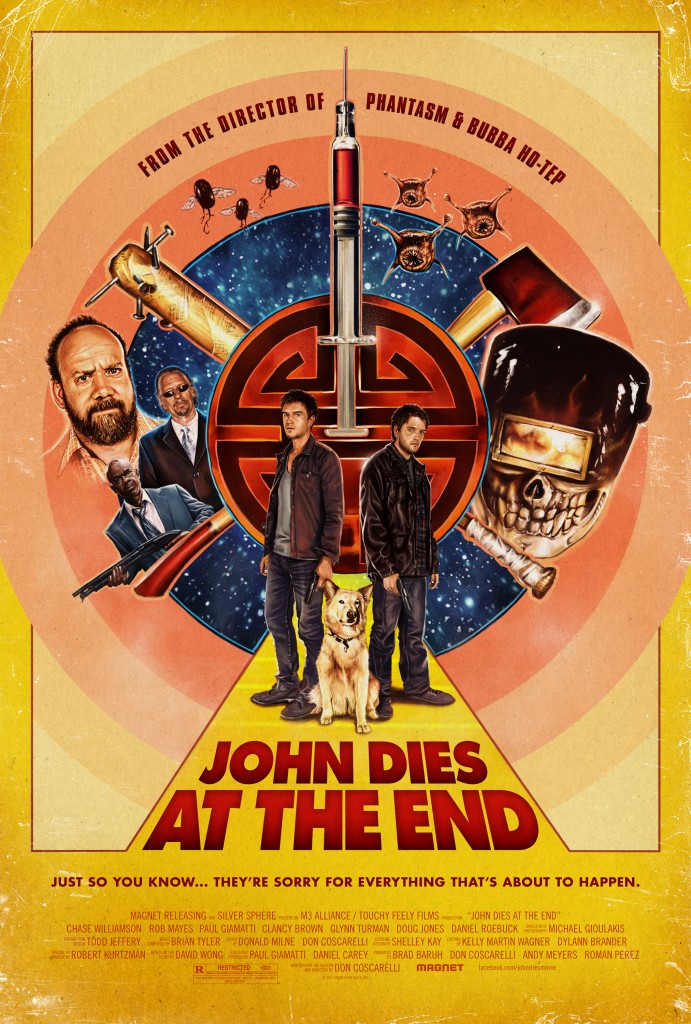
JDATEVideovista have my review of Don Coscarelli’s drug-addled urban fantasy John Dies at the End.

Based on a novel by Jason Pargin writing as David Wong, John Dies at the End follows a pair of generically handsome American youths (with ‘Close Boy Faces‘ naturally) as they are sucked into a weird and evocative demimonde in which they are compelled to battle ghosts, demons and genetically-engineered Cthuloid deities. The reason I go on at considerable length about JDATE being a work of urban fantasy is that the film is clearly desperate to escape that label:

Given the structural and social barriers involved in getting a work of urban fantasy made for the big screen, it is perhaps unavoidable that most marketing departments try to position works of urban fantasy as being part of more socially acceptable genres. Thus, The Matrix trilogy was successfully marketed as a work of science fiction, while the cowardly and ultimately unsuccessful adaptation of the Hellblazer comics was described as a ‘supernatural action-thriller’ lest girl-cooties alienate the intended audience. John Dies At The End continues this somewhat inglorious tradition with a PR campaign that tries to distance the project from the literary context that inspired the original novel, and reposition the film as the kind of gonzo horror/ comedy you would expect from the man responsible for both the Phantasm series and Bubba Ho-Tep.

The wikipedia entry for the film describes JDATE as “dark comedy-horror”.

The wikipedia entry for the book describes JDATE as “cosmic horror”.

Why should this be?

The answer has quite a lot to do with privilege and the ways in which we are socialised into a particular gender. The straight white men of today are like the painted French aristocrats of pre-revolutionary France: Pampered and protected by economic and social systems that are as unjust as they are unstable, straight white men live in unconscious fear of becoming declasse or reduced in status to a lower social rank like that of woman, BME or LGBT.

Once upon a time, the trappings of masculinity were so instantly recognisable that all a man needed to do in order to protect his privileged status was to grow a beard and either run off to war or get a job that required him to wear a tie. However, as society has been shaped and re-shaped by the tidal forces of global capitalism, the trappings of masculinity have been commodified to the point where cloaking yourself in the traditional trappings of masculinity no longer serve as a basis for differentiating one group from another. However, because straight white men are trained to take pride in their status, they are forever on the lookout for things that will identify them as straight white men and distinguish them from everyone else. Maybe it’s liking football, maybe it’s wearing sports gear, maybe it’s drinking pints, maybe it’s talking about how much you enjoy sex in a loud and boisterous manner. The problem is that every time straight white men find a way of broadcasting their group membership, fashions change and people from other groups begin adopting those characteristics. This has made straight white men hypersensitive to any product that might make them look like they might belong to a lesser social class, and this is where Urban Fantasy comes in.

Urban Fantasy shares about 80% of its DNA with Paranormal Romance. In fact, the only difference between Urban Fantasy and Paranormal Romance is that Urban Fantasy places ever so slightly less emphasis on the romantic sub-plots. This association is somewhat problematic as reading Romance novels is one of those characteristics that is so unquestionably feminine that it is enough to alienate most straight men. In fact, some straight white men are so uncomfortable with the connections between Urban Fantasy and Paranormal Romance that they have tried to re-write the history of Urban Fantasy to exclude as many female authors as possible. This is why JDATE is being marketed as “dark comedy-horror” rather than the work of cinematic Urban Fantasy it so obviously is.

Another result of the association between Urban Fantasy and Paranormal Romance is that Urban Fantasy is a genre with very little critical status. In fact, it’s quite telling that what I liked most about this film is the director’s valiant attempts at resisting genre narratives even though they were built into his film at script level. Some might argue that this is a reflection of my own privilege and failure to take the red pill and move beyond the gendered aesthetics fed to us by our culture but I’m not going to lose any sleep over it. Our aesthetic preferences are built into us on the same level as our personality traits and there’s a point at which getting free of the system is effectively indistinguishable from becoming an entirely different person.

REVIEW – Wings (1927)

WingsFilmJuice have my review of William A. Wellman’s Wings, the first ever film to win a Best Picture Academy Award.

Set during World War I, the film follows a pair of young men as they travel to France and earn reputations as fighter pilots. Initially antagonistic as a result of having fallen in love with the same aristocratic woman, the two men become friends until the madness of war consumes them both and one accidentally kills the other. As I explain in my review, I pretty much hated this film…

Wings is an absolutely terrible film: Despite having nearly two and a half hours in which to build characters and relationships, the writing fails to imbue the melodramatic plot with any real dramatic weight. For example, we are told that Jack and David hate each other before eventually becoming friends but nothing ever happens to either to stoke the fires of hatred or build a bridge of friendship. David never saves Jack, Jack never saves David and when Jack finally kills David it is done with absolutely zero pathos as the script fails to establish the idea that Jack might at one point have wanted to see David dead. The treatment of supporting characters is equally shoddy as a German-American airman is viciously bullied for comic effect while the women in the film are reduced to sex objects, plot devices, and guilt sponges in what the lead actress Clara Bow maintained was a misogynistic script even by the standards of 1920s Hollywood. Buttressed by inter-titles so ludicrously purple that they could have been lifted from a 1990s video game, the action scenes are surprisingly hit and miss given the vast resources thrown into producing them. Frequently little more than shots of military pilots flying in formation and pretending to crash, these scenes are a microcosm for the entire film as they are of little more than historical interest.

I think it says an awful lot about this film that its lead actress felt moved to complain about the sexism and the fact that her character was little more than a dollop of cream on top of the man-cake. However, the more I watched of this film, the more I came to realise its importance in determining which kinds of films were deserving of awards. As I explain in my review, this film was released in the same year as Metropolis and Sunrise and yet it feels almost childishly simplistic in comparison. Next time you wonder why it is that terrible films win Oscars while genuinely challenging and thought-provoking films are ignored, look no further than the crude sexism, jingoism and inflated budget of Wellman’s Wings.

Watching this film, I actually began to wonder whether one might argue that the American film industry owes as much to German emigres as its space programme – Without German scientists, there would be no Apollo; without German directors, there would be no Citizen Kane. Hmm.

Contrary to my editor’s suggestion, I gave this film an even-handed 3 out of 5 as I think the market for this Masters of Cinema release is most likely to be people with an interest in the history of American film and the unimaginative writing, poor visual story-telling and lazy bigotry of Wings actually reveal a surprising amount.

REVIEW – The Banshee Chapter (2012)

the-banshee-chapterFilmJuice have my review of Blair Erickson’s bizarrely incompetent horror movie The Banshee Chapter.

When I say “bizarrely incompetent”, I mean that while some of the set-pieces are incredibly effective and the opening vignette is incredibly eye-catching, the film has one of the most poorly-constructed narratives that I have ever encountered. People spit a lot of bile at the likes of Uwe Boll but despite making cheap, shoddy and astonishingly boring films, Boll is at least able to construct a cinematic world that makes some sort of sense.

Every style of storytelling has rules. Though some would argue that these rules are hard-wired into the human brain, a less Darwinian theory is that we are socialised into expecting certain kinds of story from certain kinds of work. Consider, for example, the way that Ruggero Deodata’s Cannibal Holocaust borrows techniques from documentary filmmaking and uses them to make his otherwise quite conventional horror film seem more terrifying. Another fine example of a work that transgresses the boundaries between genres is Stephen Volk’s Ghostwatch, which terrified Britain by using the tropes and faces of British TV to tell a fictional ghost story. Blair Erickson’s film also moves between a number of different genres and borrows from different cinematic traditions but rather than blurring the boundaries to create a particular effect, Erickson muddles the boundaries in a way that suggests he was incapable of telling the difference between them:

This is particularly glaring when Erickson continues to use found footage techniques despite the fact that the journalist is no longer keeping a video diary. It is one thing for the picture to go fuzzy and the camera to dart around in a panicky fashion when a terrified character is holding it, but why would there be interference and panicky camera movements when none of the characters are holding a camera? What is that interference supposed to represent? Erickson’s confusion of first-person and third-person perspectives on his cinematic world results in a world so broken and incoherent that it comes dangerously close to collapsing in a puddle of beautifully-edited gibberish.

Frequent visitors to this here site will doubtless have noticed that one of my most common complaints is that while a film may be beautifully made, it has absolutely nothing to say. This is undoubtedly a result of the fact that people can now go to film school, learn how to be a competent director, acquire the funds to make their own film and then realise that they have no particular message to convey or story to tell. While Auteur theory stresses the importance of vision and of having the freedom to fully realise that vision, it struggles when forced to content with neophyte directors who are still trying to find their feet. Undoubtedly a talented editor and a filmmaker with some potential, Erickson should have been reigned in by both a working script and a producer willing to ask uncomfortable questions but instead he seems to have been given free reign resulting in a film so stylistically incoherent that it is frequently impossible to tell what it is that we are supposed to be seeing.

Banshee Chapter could have been an atmospheric return to paths already well-trodden by the X-Files but instead it is an incoherent mess. While my review blames Erickson for his inability to tell a story, a more likely set of culprits are the producers who either failed to spot a foundering director or refused to throw him a life raft. Hollywood is now quite fond of marketing films on the basis of who produced them and the PR bullshit for this particular film listed Zachary Quinto’s involvement no less than three times. Based on Banshee Chapter alone, I’d say that ‘…from the dude who plays Spock in those terrible Star Trek movies’ is more of a bug than a feature.

The Sight of the Hunted: German Expressionism and Night of the Hunter

night of the hunter poster

FilmJuice have published a lengthy piece written in celebration of the recent re-release of Charles Laughton’s legendary Night of the Hunter.

This piece was a real joy as it gave me an excuse to not only rewatch the film for the first time in a while, but also to do some research into Laughton’s life and refamiliarise myself with some of the better works of German Expressionist cinema. I wrote quite a lengthy piece about German Expressionism for Videovista a few years but my understanding of that particular cinematic milieu has solidified somewhat and hooked up with some much larger thoughts I’ve been having about the relationship between psychological realism and fantasy in the psychological thriller genre. In my original Videovista article, I spoke about Expressionism in terms of:

Expressionism emerged as a reaction to impressionism. Impressionism, as practised by the artists Claude Monet and Pierre-Auguste Renoir attempted to break down the boundaries between subject and background in order to produce paintings that were almost like snapshots: images that were exacting reflections of the world itself. Expressionism reacted against impressionism by rejecting the call to represent the world ‘as it is’. Instead, expressionists favoured representations of the world that ‘expressed’ the artists’ attitudes towards the subject matter. They did not reflect the world, they abstracted from it. A key work in the development of expressionism is Edvard Munch’s painting The Scream (1893), in which the insane flowing colours of the background, the pale featureless visage of the screamer and the dark figures in the background express not merely a person screaming but rather a state of inner turmoil, paranoia, alienation and insanity.

Now I say far more straightforwardly:

The most influential work of German Expressionist cinema is undoubtedly The Cabinet of Dr. Caligari. Told entirely in flashback by a man who turns out to be an inmate in an insane asylum, Robert Wiene’s film is a hypnotic mess of light, shadow and unsettling angles. Too fantastical to be real and yet too raw to be fictitious, Caligari’s story of love, murder and sinister sleepwalkers is best understood as an emotional landscape, a realistic portrayal of what the real world feels like to the person telling the story. The light and darkness of Caligari’s world are absolute because they are absolute in the mind of the madman just as they might be in the mind of a child. This is the exact same idea that lurks behind the myriad eccentricities of Laughton’s Night of the Hunter.

Rather than seeing the film through the gauze of southern gothic, I view it as a quite explicitly psychological piece: The fantastical nature of many sequences and effects are not reflections of a world that is in itself fantastical but rather a reflection of how that world feels to the children and how children (and everyone else for that matter) use the culture they have consumed in order to make sense of the world around them. It is only natural that the world should resemble a fairy tale when the only time you have heard of evil priests and murderous ogres is in the pages of just such a children’s story. Far from being limited to the children’s worldview, Night of the Hunter occasionally switches to other worldviews such as those of the mother, a friendly drunk and a horny teenaged girl. This is a film that not only reaches back to a cinematic vocabulary that was largely unknown to 1950s American audiences, it also takes those Expressionistic techniques and takes them to the next level. Night of the Hunter is a film that is literally decades ahead of its time.

Mother

REVIEW – Winter of Discontent (2012)

Winter of DiscontentFilmJuice have my review of Ibrahim El Batout’s film about the Egyptian revolution Winter of Discontent.

Made in the immediate aftermath of the 2011 overthrow of Mubarak regime, Winter of Discontent follows a group of Egyptians as revolution changes their relationship with their government. Thus, one of the strands follows a TV presenter on a government network who is effectively forced out of her job for daring to ask awkward questions of politicians. Initially, this makes her incredibly fearful for her life but as events in Tahrir square unfold, we see her becoming increasingly bold and defiant before eventually switching sides and using Youtube to denounce the corrupt government. This story is beautifully juxtaposed with that of a secret policeman who moves from a position of absolute certainty in which he feels free to threaten and torture respectable citizens to a position where he owes his family’s safety to the forgiving nature of brutes with sticks.

Let me be clear, despite its shortcomings, I very much enjoyed Winter of Discontent and part of what made the film enjoyable was the fact that it was an incredibly middle-class film made by middle-class Egyptians about their experience of political upheaval. According to the filmmakers, this was a decidedly quiet revolution and that is something of a cinematic rarity:

Sergei Eisenstein’s immortal Battleship Potemkin begins with sailors eating maggoty food and ends with many of those exact same sailors cheering the revolution as their fellows decide to join them in open revolt against the Tsarist regime. Ken Loach’s magnificent ode to the Spanish Civil War Land and Freedom contains oodles of dead fascists and Spanish peasants finally getting a say in how to work their own fields but it ends with the granddaughter of a dead veteran giving a sad but defiant raised fist salute. These cinematic accounts of real-world revolutions may be brilliant, maudlin, triumphalist and manipulative but one thing they are not is quiet. By this measure alone, Ibrahim El Batout’s Winter of Discontent is something entirely unique: a quiet film about revolution.

Watching this film made me reflect on Western attitudes to revolution as I feel most people’s aversion to the idea of overthrowing their government stems from the fact that they are afraid of what might happen to them. This fear is perfectly captured in Marjane Sattrapi and Vincent’s Paronnaud’s Persepolis where a liberal middle-class family wind up being judged and mistreated by uneducated working class people who have been placed in positions of authority by the new regime. One of the fascinating things about Winter of Discontent is that it is entirely free from this sort of class-bound paranoia… the characters sense that something is wrong and face down brutal oppression in order to speak out but while one of the characters is a bit mistrustful of his uneducated upstairs neighbours, his feelings of solidarity quickly overwhelm any misgivings he might have had about the great unwashed. A more romantic and — dare I say it? — politically engaged director might have made a good deal more of that moment of solidarity but El Batout handles it with a quiet restraint that is actually quite refreshing.

REVIEW – Upstream Color (2013)

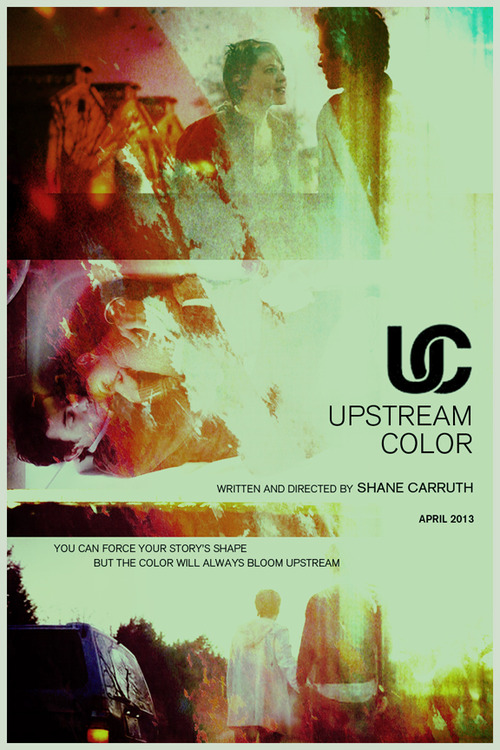
Upstream-Color-PosterFilmJuice have my review of Seth Carruth’s art house SF film Upstream Color, which came out this week on DVD and Blu-ray. I loved the film but it also made me intensely aware of the limitations of certain styles of cinematic storytelling.

At the heart of Upstream Color is a very conventional relationship movie: Two fragile people struggling to overcome life-threatening traumas meet on public transport and immediately recognise themselves in each other. Initially quite tentative, the two fragile people orbit around each other; feeling the attraction but afraid of getting too close lest they get sucked in. When the pair do eventually commit to each other they connect on such a profound level that the lines where one person stops and another person begins begin to blur. Whose memories are these? Whose emotions are these? Am I me? Are you me? Told in a way that emphasises visual storytelling over verbal exposition, Upstream Color looks and feels very much like the type of film that European art house cinema has been churning out for the last fifty years. World cinema is a very different cinematic tradition to that of Hollywood but the techniques and themes favoured by that tradition mean that Carruth can quite easily pick up their tools and tell yet another story about alienated people undergoing the ambivalent process of change associated with love and the construction of a couple’s subjectivity. This cinematic vocabulary is a mature system and Carruth is a talented-enough director to use those tools to tell a really effective if ultimately unchallenging relationship story. However, Upstream Color is a lot more besides…

Halfway through watching the film, I pointed out on Twitter that Upstream Color felt a lot like someone using an iPad to make scrambled eggs. What I meant by this was that while the core story was really quite mundane and unadventurous, Carruth tells his story using one of the richest and most complex metaphorical infrastructures in recent cinematic history. Yes, this film is all about empathy and Carruth uses an explicitly Science Fictional device to explore how empathy can open us up to good as well as bad experiences, Carruth’s device is actually a lot more complex than a traditional relationship drama would require. Indeed, while Buffy the Vampire Slayer trod similar ground by making Buffy temporarily telepathic, Carruth cracks the egg of human relationships with the genre equivalent of a sledgehammer. A worm that, when consumed, puts people in state of such psychological vulnerability that someone can effectively clean out their bank account, destroy their life and order them to forget the whole thing. Even more conceptually lavish, Carruth explores the life-cycle of these worms and how, once removed from a human host, they allow people who understand the technology to ‘check in’ and watch the people that were once infected. Frankly, there are enough ideas and story-hooks in these worms to support and entire film festival but Carruth only really begins to exploit the thematic potential of his device at the end of the film:

Aware that his genre tropes can probably handle a lot more than a simple relationship story, Carruth devotes the final act to pushing the limits of his metaphorical infrastructure and so we are treated to an absolutely beautiful sequence in which the life-cycle of the worms is revealed and a further sequence in which Jeff and Kris confront their shared trauma and tentatively begin edging towards a less isolated way of living. Carruth handles both of these expansions quite well but the combination of oblique storytelling techniques and limited space means that much of their thematic and dramatic potential must remain untapped. Indeed, Terrence Malick’s The Tree of Life spends over two hours wrestling with ideas far less substantial than the ones that Carruth rushes through in less than ten minutes!

In an age when both art house and mainstream directors are making films based on tired and insubstantial ideas, it is both refreshing and slightly overwhelming to encounter a film that could easily have been a trilogy or a series. Upstream Color is not just an incredibly beautiful and well-told story, it is a film so full of ideas and thematic resonances that it is almost too frustrating to watch. Sitting through Upstream Color I was struck by the extent to which art house cinematic techniques struggle to convey new types of information. Watch enough art house films about alienated people trying to get their lives back on track and those techniques are incredibly effective at conveying mood and theme but ask those techniques to explore the psychic fallout of discovering that you are only one of hundreds of people who have been secretly observed by shadowy figures and those techniques begin to struggle. Upstream Color could have been about the NSA and Google dismantling privacy, it could have been about post-traumatic stress or it could have been about the psychic fallout from being involved in a mass event like a terrorist atrocity or a religious cult. It could have been about any of these things and yet the film ended too soon.