The Films of Nicolas Winding Refn and NWR by Laurent Duroche

Long-time visitors to the site will know that I have something of a love-hate relationship with the films of Nicolas Winding Refn.The relationship began in 2008 when I went to see his singular and yet problematic biopic Bronson. Soon after that, I was completely blown away by the viciously gritty realism of Winding Refn’s Pusher trilogy. A few years later, I was going through something of a ‘viking’ phase during which I read several books about the period. Upon hearing that Winding Refn’s next film Valhalla Rising was a Conradian take on vikings, I immediately dragged my partner to a film festival where it was screening. The result was something of a disappointment. Winding Refn had won my devotion by crushing the bones of modern life and sucking the marrow from them without using the increasingly hide-bound techniques of european art house film. Indeed, you are more likely to see someone get shot to death in a Winding Refn film than you are to see them staring meaningfully into the distance. When the time came for me to review the film, I voiced my extreme ambivalence and disappointment in a post over at Videovista:

This is art with the creative impulse kept in chains and passed back and forth between worn-out chieftains. This is the kind of film that makes you strain to remember the last time you were genuinely shocked or surprised at the cinema. This is art that leaves you yearning for a gust of fresh air that will blow away the cobwebs. This is the revolutionary corrupted into the familiar. The transgressive repackaged as the formulaic. This is what creative stagnation looks like and I find that almost unbearably depressing. As someone who is not only a huge fan of Conrad but also of Malick, existentialism and Vikings, Valhalla Rising should have been my ideal film but instead it left me feeling that I had seen it all before just one too many times.

This is basically the art house intellectual equivalent of nerd rage. My annoyance at the film was such that I even felt obliged to unpack my feelings even further in a piece inspired by James Woods’ extended critical essay How Fiction Works and Thomas Clay’s Soi Cowboy. Valhalla Rising left a deep wound in my appreciation of film, it marked the point where I stopped celebrating art house film and began questioning its methods and its metrics of success.  Valhalla Rising is not the work of a free spirit, it is the work of someone who is reaching out to the art house establishment in search of recognition and legitimacy. Valhalla Rising is the work of an outsider who wants to come in from the cold and the exact same thing can be said of Thomas Clay’s Soi Cowboy, Andrea Arnold’s Wuthering Heights and Steve McQueen’s Shame. All of these films bend the knee to the European art house establishment and so come off looking like genre pieces. The problem is that the techniques that once revolutionised European filmmaking in the 1960s have become ossified and so European art house film is now little more than a genre that talented directors attempt to move beyond.  As Woods puts it:

When a style decomposes, flattens itself down into a genre, then indeed it does become a set of mannerisms and often pretty lifeless techniques

Winding Refn’s willingness to bend the knee was amply rewarded when his next film Drive became one of the most widely celebrated films of 2011.  Full of violence and exploitation film tropes, Drive seemed built for the US market and yet it managed to convince art house fans as well as critics. Had Winding Refn not made a film as conventionally arty as Valhalla Rising, I suspect that Drive would never have won over art house critics.  It is too American… too violent… too exciting… too plot driven. The Imp of the Perverse that sits on my shoulder decided that I should hate Drive on general principle and yet I did not. In fact, as I said when I reviewed the film, I consider it to be one of the greatest films of all time… if only for this scene:

I could watch it all day: The dimming of the light, the way he starts to pull away before she does and the way he steps back before exploding into action in a way that pleads ‘just give me one more second of this feeling… one more second before I have to do something horrible’. There is genius in that scene and there is genius in Drive as a work of cinematic art. It is a thousand miles from the sterile art house nonsense of Eugene Green’s Portuguese Nun and Carlos Reygadas’ Stellet Licht.

Given that I adore the work of Nicolas Winding Refn, I was delighted to discover a documentary about his work. Filmed as Winding Refn scouts out locations in Bancock, Laurent Duroche’s NWR is a wonderfully candid piece that reveals a lot about how Winding Refn works and how he thinks his way through particular projects. Particularly interesting is the fact that Winding Refn actually turned down the chance to go to a prominent Danish film school and chose instead to use the money to make Pusher. The film, and many other fantastic films like it, are made available for free online and are collected at the absolutely awesome Cinephilia&Beyond Archive.

I am particularly enamored with the film as it opens with some fantastic comments in French by the great surrealist filmmaker Alejandro Jodorowsky. This opening section, sadly devoid of English subtitles, translates as:

You have to understand one thing. Cinema has arrived at a disappointing stage: Complete industial degeneration. With this pulp… this cancer that is American cinema has infected the entire planet. It has political power… it has economic power… it is a pile of spiritual excrement. Then, when we had lost absolutely all hope, when we saw that all films were lit in exactly the same way… with that degenerate Spielberg… When we find ONE artist who can survive (despite having to earn a living) and who BREATHES… it is a moment of supreme joy. The boy Nicolas saved me from my cinematic depression

REVIEW – The Rafi Pitts Collection (2012)

Back in April 2011, I reviewed Rafi Pitts’ The Hunter, a superb insertion of 1970s American paranoid cinema tropes into a depiction of contemporary Iranian society. Evidently quite successful, the cinematic release of The Hunter has prompted the good folks at Artificial Eye to put out a box set of Pitts’ films including The Hunter but also the exquisitely moving It’s Winter (2006) and Pitts’ far more conventional early feature Sanam (2000). FilmJuice have my review of The Rafi Pitts Collection.

One of the pleasures of this box sex is that it allows you to survey the development of a creative talent. Though beautiful to look at and entirely decent, Pitts’ Sanam is a highly generic exercise in wrangling world cinema tropes. Indeed, the colourful photography and plot featuring a young boy struggling to get over the death of his father could have been made by any world cinema director in any country in the world. Having mastered the world cinema genre, Pitts then begins to process of developing his own sensibility. Intensely poetic and filled with chilly urban alienation, It’s Winter is demonstrably a far better film than Sanam and a far better film than we have come to expect from most world cinema directors who seem mostly content with toeing the line and giving western art house audiences exactly what they expect of a particular country. This cold and urban sensibility finds its ultimate fruition in the paranoia and repressed violence of The Hunter, which is easily Pitts’ best film to date:

The Hunter tells of a reformed criminal struggling to find salvation in the role of husband and father. The problem is that, while the film’s protagonist is quite content to go straight as long as he can spend time with his family, his employers use his criminal past as an excuse to make him work nights thereby ensuring that he rarely gets to see his family. When something terrible happens and the man’s family disappears, the man understandably goes nuts and begins hunting Iranian policemen. At this point, the film transitions from being an account of social injustice to being a tense paranoid thriller in the style of Taxi Driver and The Parallax View. Just as beautifully shot as Pitts’ earlier films, The Hunter juxtaposes the cold urban landscapes of It’s Winter with the warm naturalism of Sanam only to find that the Iranian police will chase you down through both sets of landscapes. Intriguingly, the film’s ending obliquely hints at the possibility of future uprisings. How much mistreatment will the Iranian people endure before, much like the hunter, they snap?

Also fantastic is the interview with Pitts that is included on the second disk in the collection. Many creatives, though clearly intelligent, lack either the self-awareness or the personal openness required to shed much light on their working processes, Pitts is clearly not one of those types of creatives. Witty, insightful and astonishingly candid about the choices he made during the shooting of It’s Winter, the interview is a timely reminder of quite how much a good DVD extra can add to the experience of watching a film.

Five Great Films by Billy Wilder

After years of somewhat patchy DVD coverage, the films of Billy Wilder are finally getting the DVD releases they deserve. In celebration of this fact, I have written a piece for FilmJuice listing my five favourite Wilder movies. The list includes — in no particular order — The Lost Weekend, Sunset Boulevard, Double Indemnity, Some Like it Hot and Murder Mills.

My take on Wilder is that many of his films feature a tension between brutal cynicism and crowd-pleasing optimism that sometimes cuts very close to the winds of mushy sentiment. Had Wilder been anything less than a great director, this tension would most likely have resulted in some spectacularly dishonest filmmaking. However, each of the films I explore in the article work because they are all heart-felt journeys out of cynicism and into the light. In each case, you can follow the path and see Wilder talking himself down off the edge:

Billy Wilder is the most sentimental filmmaker to ever acquire a reputation for cynicism.

As I worked my way back through Wilder’s films (including some of the decidedly less interesting works produced late in his career) I couldn’t help but wonder about the tension between cynicism and romanticism. Indeed, if Wilder’s films are to be understood as the product of a mind endlessly seeking reasons to be cheerful, what does this say about the wider relationship between cynicism and romanticism? Are all cynics disappointed romantics? Are all romantics naive cynics? Wilder’s films certainly suggest some form of connection between the two dispositions.

REVIEW – Wasted on the Young (2010)

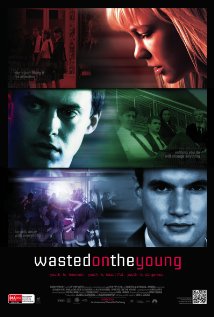
THE ZONE has my review of an interesting Australian film by first-time director Ben C. Lucas. Wasted on the Young is stylishly shot high school mystery in very much the same tradition as Rian Johnson’s Brick. Aside from the intriguing plot and the deliciously chilly cinematography, what really grabbed me about this film was its attempt to get inside the head of contemporary teenagers whose every move is recorded by CCTV cameras and whose every thought is captured by social media:

 As William Gibson’s recent writings have suggested, there was a point when society changed and certain ideas ceased to be science fictional. Yesterday’s cyberpunk futurism is today’s kitchen sink realism. Similarly, many old realist touchstones appear to be little more than genre affectations tainted by reactionary nostalgia. We no longer live in a world where women can afford to be bored doctor’s wives. Virginia Wolfe once described George Elliott’s Middlemarch as one of the few British novels written for adults but when read today, the book appears about as realistic as a quest to destroy a magical ring. By borrowing elements from the hard-boiled and cyberpunk genres while simultaneously downplaying the fictional character of these elements, Lucas is attempting to capture what it feels like to grow up in a world with its own set of realist touchstones and its own set of worries and concerns.

Watching it I was reminded not only of the more recent works by William Gibson but also the short stories of Tim Maughan (some of which I reviewed a little while back). What unites these works is a realisation that, rather than simply adding to an already existing world, the internet and social media are changing the world by sculpting how young people learn to see and react to the world. Literary theorists have spent the last 100 years bemoaning the fact that we are now modern and as such have severed our ties to the gods of our forefathers. Similarly, transhumanists spend much of their time banging a drum for the change that will come with the arrival of the Singularity. The more I read and the more I think about today’s youth, the more I realise that there is no great Death of Pan or Birth of the Singularity… there’s just some old fucks dying and some young fucks taking their place. Society is in constant evolution and social media is one particular area of genetic drift. In 10 years (let alone 100), people will wander what it was like to live without the internet and so any work of art that does not engage with the social changes created by the internet must be seen as little more than a side-show.

Gibson’s decision to re-position himself as a mainstream writer rather than a genre writer is the product of two forms of change: Firstly, society has changed to the point where science-fictional ideas are now realistic ideas. Secondly, Gibson needed to leave genre because genre has no interest in writing about the world that we are currently making for ourselves. Wasted on the Young is yet more evidence that science fiction has run its course as both a literary tradition and a sub-culture as it is easily as cyberpunky as any of Gibson’s recent novels and yet it presents these scientific and social ideas as nothing more than grindingly mundane realism.

REVIEW – Crows Zero (2007)

In a recent review over at FilmJuice, I moaned about the tendency of Western distributors to only pick up the films that chimed with Takashi Miike’s reputation for producing horrifically violent cinema. However, Miike’s recent acquisition of mainstream respectability thanks to Thirteen Assassins (2010) and Hara-kiri: Death of a Samurai (2011) means that more and more of his lesser films are finding their way to US distribution. Yatterman (2009) is one example of this, Crows Zero (2007) is another.  THE ZONE has my review of the latter.

What I liked about the film is that it takes quite a traditional hero’s journey plot structure and neatly dovetails it with quite a melodramatic approach to characterisation meaning that despite being nothing more than a series of confrontations leading to a final battle, the film never feels overly episodic:

While the foreground of Crows Zero is dominated by the need to conquer the school, the subplots all revolve around the tensions between what the individual wants and what people expect of them. Thus, Ginji struggles with both the expectations of his father and the expectations of his followers while Serizawa tries to cope with the fact that his gang expects him to deal with Ginji despite the fact that he thinks the pair could probably be quite good friends. In true yakuza picture style, these tensions are explored in a highly stylised and melodramatic manner that owes more to opera than it does to gritty crime fiction. In fact, one subplot resolves itself by having someone bellowing their devotion into a rain-soaked sky while another subplot resolves itself through an epic all-day battle sequence. As the film progresses, this movement between genres proves itself to be remarkably effective as the melodrama distracts from the episodic structure of the plot while the humour and violence prevent the film from getting bogged down in self-indulgent teenaged angst. However, while Crows Zero neatly sidesteps the problems associated with both of its parent genres, the film does possess its own set of problems.

These problems are derived from the fact that, rather than constructing the series as one would a traditional cinematic trilogy, Miike directly imports the narrative conventions of shounen manga. Shounen manga narratives frequently span dozens and dozens of books and in order to support these astoundingly lengthy narratives, manga writers have developed their own set of techniques that are very different to those of cinematic series. While the techniques required to sustain lengthy cinematic series are evolving in light of franchises such as The Avengers, Miike’s use of narrative techniques derived from manga feels like too much change far too quickly resulting in some astonishingly awkward plotting. As I say in the review, I can imagine how these techniques might work in the context of an entire series, they are really quite distracting in the context of an individual film (indeed, given that the sequel exists and is now three years old, I think it was a major mistake not to release both films as a box set).

REVIEW – The Island of Lost Souls (1932)

FilmJuice have my review of Erle C. Kenton’s much under-loved The Island of Lost Souls starring Charles Laughton and Bela Lugosi.

The film is a product of the 1930s Golden Age in American horror that produced many of the great American movie monsters. Based on H.G. Wells’ The Island of Doctor Moreau, The Island of Lost Souls was banned in the UK because of its tendency to deny God and play with the idea of inter-racial and inter-species sex. Indeed, to say that this film is racist would be something of an understatement as it represents an almost flawless articulation of White America’s fear that non-whites will someday rise-up and, in the immortal words of Hunter S. Thompson, savagely penetrate every orifice in their bodies with their throbbing, uncircumcised members:

The film’s use of the word ‘native’ to denote the man-beasts is hardly accidental as it panders to double-edged racist fantasies about non-white people being more animalistic than American Christians. I use the word ‘fantasies’ advisedly as this belief in the passionate nature of non-white people extends not just to their perceived capacity for violence but also to their atavistic sexualities. Thus, when Parker kisses Lota and recoils in disgust, his disgust is born not only of inter-racial and inter-species revulsion but also from the realisation that he enjoyed kissing the savage far more than he did his immaculate groomed white fiancée.

Interestingly, the film is currently considered to be out of copyright meaning that you can watch it for free on Youtube. However, the good folks at Eureka have done a fantastic job of packaging the film up with a series of interviews and essays and the print used for their release is fantastically clear so I definitely recommend picking up their edition rather than watching it for free on the internet.

REVIEW – Manhunter (1986)

THE ZONE has my review of Michael Mann’s recently re-issued psychological thriller Manhunter.

To put it simply, I adore this film. I adore the moody electronic score, I adore Dante Spinotti’s ridiculously colourful cinematography and I adore the way that Michael Mann lines up his shots. However, what I particularly love about this film is the way that it treats the character of Hannibal Lecter as a painstakingly-repressed dark side rather than a scenery-chewing panto dame:

 When Graham visits Lecktor in the hospital, we are told it is because he is hoping to rekindle the creative fires that allow him to project himself into the mind of a killer. However, rather than simply visiting Lecktor in the hospital, Graham reaches out to the disgraced psychiatrist in the hope that his superior understanding of human nature might shed some new light on the case. This act of deference to Lecktor’s superior expertise is deeply troubling when considered alongside Mann’s cinematic blurring of the line between psychologist and psychopath. Indeed, by having Graham turn to Lecktor as part of his own creative process, Mann seems to be suggesting the existence of a symbiotic relationship between the two men. In fact, one could interpret the scene as a sort of vision quest in which the creatively frustrated Graham turns to his painstakingly repressed dark side in order to unblock the empathic powers that will allow him to solve the case.

Mann’s take on Lecter is particularly fascinating as this film was adapted from Thomas Harris’s novel Red Dragon (1981) before Harris even wrote The Silence of the Lambs. In other words, this is a vision of Red Dragon that is completely untainted by the decision to reinvent Lecter as some kind of brain-eating antihero. Released on an absolutely flawless Bluray that makes it look like a brand new film, this re-issue offers an excellent opportunity to rediscover one of the best and most under-rated psychological thrillers of all time.

The Cannes Film Festival Has a Duty to be Inclusive

If there is one thing that the Internet loves (aside from cat pictures and moral outrage) it is disagreeing with awards. Whenever an award is announced, you can guarantee that people will be on the internet within minutes registering their disgust and incredulity: ‘How could they give to prize to X’ they scream, ‘when Y was clearly the better novel/film/sex toy/advertisement for motor oil!’ Compared to other awards, the Cannes Film Festival’s Palme d’Or tends to come in for something of an easy ride as critics generally choose to celebrate the winners rather than grump about the losers. There are a number of reasons for this:

Firstly, even when the Cannes jury gets it wrong it generally does so for reasons that are quite interesting. For example, when the 2004 Jury chaired by Quentin Tarantino looked past such fantastic films as Olivier Assayas’s Clean, Wong Kar-Wai’s 2046, Lucrecia Martel’s La Nina Santa, Paolo Sorrentino’s Le Conseguenze dell’Amore, Park Chan-wook’s Oldboy and Apichatpong Weerasethakul’s Sud Pralad in order to award the Palme to Michael Moore’s baggy, manipulative and self-indulgent political documentary Fahrenheit 9/11, people generally saw it as an entirely justifiable decision to channel the media interest generated by Cannes into an assault on the Bush regime and its dubious foreign policy.

Secondly, despite the medium of film being grotesquely over-represented in mainstream media, Cannes is really the only time when entertainment reporters focus their attentions solely on the world of art house film. Only too aware that this might be the only chance they get to push these films at a mainstream audience, film critics generally choose to downplay controversy and negativity in favour of celebrating the positive and so raising the mainstream profile of art house film.

Thirdly, unlike most awards that are given out retroactively to works released within a particular timeframe, the Palme d’Or is only awarded to films that are officially in competition at Cannes. What makes the competition so peculiar is that many of the films that are in competition at Cannes also premier at Cannes meaning that unless you happen to be in Cannes during the festival, chances are that you will not get to see any of the competing films until they are picked up for distribution. This quirk of administration means that anyone not at Cannes is effectively excluded from the conversation. Furthermore, the Cannes film festival only lasts about ten days meaning that most critics struggle to see all of the films in competition. Taken together, these two sets of considerations ensure that, come the end of the Cannes festival and the announcement of the Palme d’Or winner, almost nobody in the world has seen enough of the shortlist to be able to criticise the jury’s selection in any meaningful way.

These three barriers to criticism effectively ensure that all press coverage devoted to the Palme d’Or is either a series of uplifting platitudes about the wonders of art house film or objective and dispassionate reportage that a group of people watched a group of films and determined one film in particular to be better than the others. By and large, this media love-in works quite well as the increased visibility generated by Cannes and the Palme d’Or not only creates an international market for decidedly non-commercial films, it also provides producers with an opportunity to find people to distribute their films and thereby satisfy said international market. Unfortunately, it is precisely because Cannes plays this key role in determining which films achieve wider cinematic distribution that its selections must be scrutinised and its juries held to account.

Continue reading →

REVIEW – Yakuza Weapon (2011)

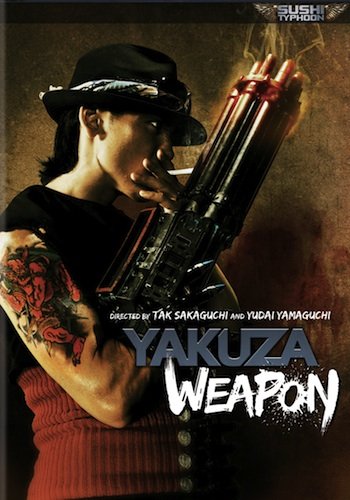
THE ZONE has my review of Tak Sakaguchi and Yudai Yamaguchi’s muddled and disappointing Yakuza Weapon.

The film presents itself partly as a genre spoof and partly as an earnest exercise in splatterpunk excess.  Unfortunately, like many recent American attempts at producing a high-budget exploitation film, the film winds up feeling forced and spread too thinly.  In my review I explain why this should be:

Back in the late 1950s, filmmakers like Roger Corman realised that there was good money to be made in pandering to youthful audiences. This insight spawned a business model whereby young directors were given small pots of money and instructed to go off and produce something sensational and titillating that might appeal to people from their age group. This business model proved remarkably effective and fueled not just the craze for drive-in movies but also the kinds of exploitation film that played in grind-house cinemas all over America. Given that these filmmakers frequently operated with very little guidance beyond the need to ramp up the sex and violence whilst remaining under budget, exploitation filmmaking rapidly became a sort of Darwinian swamp in which ambitious directors experimented with new techniques in the hope that their films would out-compete those of their contemporaries. However, as with all evolutionary processes, exploitation film produced far more failures than it did successes meaning that for every John Carpenter and Dario Argento there were dozens of Uwe Bolls.

Fast-forward 30 years and the kids who grew up watching exploitation films became the cigar-chomping producers who handed out pots of money. Mindful of the market for nostalgia, these producers green-lit a series of high profile projects designed to tap into the market for exploitation-style filmmaking. Cue the emergence of films such as Quentin Tarantino’s Deathproof (2007), Robert Rodriguez’s Planet Terror (2007), Sam Raimi’s Drag Me To Hell (2009), Patrick Lussier’s Drive Angry (2011), and the entire back catalogue of Neveldine/ Taylor. Though not without its artistic and commercial successes, this grind-house revival suffers for the fact that most of its excesses come not a desperate need to do something radically different in order to stretch a budget and capture an audience but from a deliberate attempt to parody or recapture the insane experiments of the past.


Part of the joy of watching exploitation films lies in their sheer unpredictability. Exploitation filmmakers are so desperate to find an audience that they will do anything to capture our attention and this can produce some really memorable cinematic moments. However, when the director is provided with a lavish budget in order to intentionally recapture that feeling of desperate experimentation, the results invariably feel forced and stage-managed like some grim party where everyone is so desperate to have a good and crazy time that the excess of good will completely smothers all spontaneity and freedom. Technically flawed and way, way, way too long for what is essentially a two joke film, Yakuza Weapon is disappointingly dull.

REVIEW – Yatterman (2009)

My review of Takashi Miike’s Yatterman has just gone live over at FilmJuice.

Wheeled out as part of an attempted relaunch of a children’s anime franchise from the 70s, Yatterman is absolutely fantastic to look at: The design is sensational, the special effects superb and the action sequences flawless. Most interesting of all is the fact that Miike did not feel in anyway compelled to ‘darken’ the source material as Western directors have insisted on doing when adapting video games and comics. Of course, this ‘darkening’ betrays a deep-seated distrust of the source material; comics and video games are not a fitting subject matter for film and so any attempt to adapt them for the screen must go out of its way to appear ‘mature’ and ‘series’ even when it is nothing of the sort. As a result of this refusal to betray the source material, Yatterman is delightfully bright and poignantly childish… I mean, the opening scene sees a giant robotic chef fighting a giant robotic dog. Grimdark this ain’t. However, while this is all very interesting from a design point of view, it does not make for a particularly interesting film as the characters and plots are taken directly from the source material and 70s children shows are not known for their robust characterisation. Even in Japan.

The only thing preventing Yatterman from being completely unwatchable is Miike’s decision to present the characters as brightly-coloured cartoons that secretly yearn for a normal adult life:

Furthermore, the film suggests a similar tension between adult sexuality and bawdy anime-style humour. Indeed, when perverted baddy Boyacky (Namase) reveals his innermost desire to possess all the schoolgirls of Japan we assume his desire to be sexual in nature. However, when we cut to the inside of Boyacky’s fantasy we learn that he desires nothing more than to paint their toes. Thus, the man who spends the entire film leering down cleavages, peeking up skirts and drooling at unexpected nudity is revealed as being so sexually stunted and emotionally immature that he literally cannot imagine himself having actual sex with another human being.

In other words, either you spend your time leering at moe figurines or you get to have proper sex with people. You can’t have it both ways. Given that the anime attached to this film is filled with fanservice and that the film itself was presumably financed on the assumption that it would pander to otaku, you have to salute Miike’s bravery. Even Michael Haneke never went so far as to call his audience a pack of emotionally stunted virgins.