Millennium Actress (2001) by Satoshi Kon

millennium_actressKon’s magnificent debut Perfect Blue used animation to project the audience into the troubled psychological hinterlands of a woman who is attempting to reinvent herself as a serious actress. Kon’s second film, Millennium Actress uses a similar set of themes and techniques but rather than focussing on the painful process of becoming an actress, the film looks back over the life and career of a woman who managed to become precisely what the world of film required of her.

Millennium Actress opens on a director and cameraman making their sweaty way up a large hill. At the top of the hill is a house. Inside the house is a reclusive and long-retired actress based upon the legendary Setsuko Hara (who unexpectedly retired in the same year that the director Yasujiro Ozu died). Once the actress begins talking, Kon removes us from reality and positions us alongside the camera crew inside the woman’s memory. However, as the actress speaks, the world of the film shifts from memories of her childhood to memories of her life on set as a child actress and finally to memories of the roles she played on films. “What are we shooting?” asks the cameraman as samurai clash; cities burn and youthful actresses wring their hands in melodramatic lamentations. Good question.

Initially, Millennium Actress feels like a journey into senility. Ronald Reagan reportedly confused the things he had done on film with the things he had done in reality and the film’s movement between memories of making films and memories of film suggests a similar form of confusion. However, as the film progresses and the boundaries between films begin to dissolve, a pattern begins to emerge: each of the actress’s roles drew upon the realities of her life at the time of filming. Thus, by revisiting each of the roles the actress played, the camera crew are witnesses to the emotional beats of the actresses’ life. The further the film progresses, the older the actress becomes, the quicker she ages and the more her life comes to resemble a head long rush towards the grave. While the film’s opening acts sometimes feel like an elaborate but hollow technical exercise, the conclusion weaves all of these disconnected threads into the magnificent tapestry of a life in film.

Much like Paul Schrader’s biopic Mishima: A Life in Four Chapters, Millennium Actress explores not only the importance of the creative process in the lives of creative people, but also the way in which these very public displays of emotion forge a bond between the audience and the artist. Kon brilliantly explores the nature of this relationship by having the director insert himself into the memories of the actress in order to serve as her protector and guardian of the sacred flame. Aside from keeping the actress’s flights of fantasy on track, the director also directs her attention to the areas of her life that he finds most interesting suggesting that, far from being passive, fans can have a good deal of control over the lives of their idols.

Though undeniably a touching tribute to the enduring power of film, Kon’s film suggests that the relationship between performer and audience is actually a good deal more complex and problematic than we might otherwise believe. Indeed, despite being a central figure in the lives of millions of people, the actress never quite got to live her own life on her own terms. Great emotions flowed through her and back towards her but they never really belonged to her… they were never entirely private… never entirely personal.

In a sense, Millennium Actress is the perfect response to Perfect Blue as it answers that film’s un-posed question: Why would someone want to put themselves through the dehumanising and humiliating process of becoming an actor? Because to be is to be perceived and to feel is to be felt.
Five Intelligent Science Fiction Films

children-of-menFilmJuice have just published my latest feature. In honour of the British release of Cloud Atlas, here is my list of five literary science fiction films.

These types of feature are really quite formulaic, the list post is a staple of most major websites and I do little to subvert the format. However, while many such lists seem content to list anything that isn’t a disaster movie or an action film, I’ve attempted to select films on the basis of their vision and relevance. Somewhat unsurprisingly, I end the piece by singing hosannas to the glory of Curaon’s Children of Men:

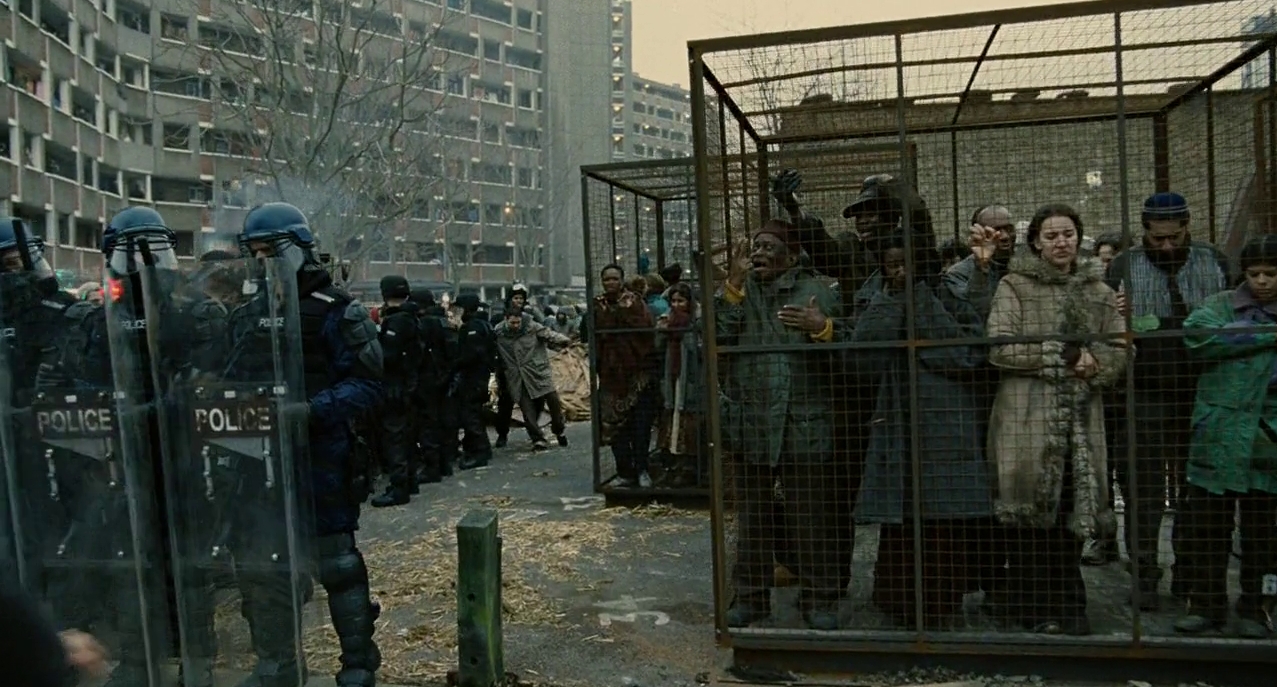
Cuaron’s Children of Men takes place in a future Britain where the sudden and inexplicable sterility of the population has resulted in an even greater form of cultural blockage than the one we are currently experiencing. Without young people to stir things up and challenge orthodoxies, Britain has retreated into a bitter nostalgic conservatism where branded coffee shops sit beside cages full of foreign refugees and pleasant middle-class people withdraw into artfully decaying farm houses filled with relics of their long-abandoned ‘politicised’ youth. Even when The Revolution finally comes, it feels like a mass-market greatest hits album: Masked Islamic gunmen parading their martyred dead West Bank Style, under-equipped paramilitaries firing through the windows of abandoned schools Sarajevo Style, futuristic soldiers standing around impoverished suburbs Baghdad Style: Now That’s What I Call A Revolution! Volume 666.

People interested in this sense of cultural blockage might also be interested in my piece about the Cowardice, Laziness and Irony of literary science fiction and Mark Fisher’s eternally brilliant book Capitalist Realism.

REVIEW – Lisa and the Devil (1974)

LisaandDevilFilmJuice have my review of Arrow Films’ recent re-release of Mario Bava’s post-gothic fantasia Lisa and the Devil (a.k.a. House of Exorcism).

This review probably makes most sense when read in concert with my review of Bava’s earlier film Black Sunday. As I pointed out in my review, Black Sunday‘s Gothic imagery works solely because the film is shot in black and white. Lisa and the Devil deploys a similar set of Gothic tropes (skeletons, ghosts, sinister mansions) but because the film is shot on Eastmancolor (the successor to Technicolor), the film lacks any real atmosphere meaning that the Gothic imagery feels forced and slightly silly. One explanation for Bava’s decision to revisit Gothic tropes on colour film is that the sense of artificiality is intentional and used as a means of drawing our attention to the fantastical and unreal nature of the world the character has inadvertently entered. Indeed, while the film is ostensibly about a young woman who is lured to a sinister mansion by the Devil, one could also read the film as a meditation upon Bava’s career as a director. After all… how many women did the great horror director lure into Gothic mansions as a part of his job?

This feeling of artificiality is fiercely reminiscent of Shakespeare’s final play The Tempest and both works feel like products of an aging creator reflecting upon the theatricality of their own lives. However, while Shakespeare clearly identified with the aging wizard Prospero, Bava appears to identify with Savalas’ satanic butler, a character forever fussing with cheap special effects and grease paint in an effort to control what people see and how they feel. The melancholic nature of this identification is even more evident when Lisa snaps out of her reverie amidst wax dummies and ruined buildings: when the film ends, the audience picks up their stuff and leaves while the reality of the film decays in their minds and nothing is left but ghosts.

Another reason for picking up this dual format release is that Arrow Films have consulted a collection of critics who really engage with the fact that this film was released in a number of different places and a number of different forms.

One of the most prominent vestiges of auteur theory is the idea that a director’s final cut of a film is somehow more authoritative than alternate versions. Though rooted in the cult of the director-as-auteur, this vision of the creative process owes much of its popularity to Ridley Scott’s very public dissatisfaction with the original cut of Bladerunner. When the director’s cut of Bladerunner was finally released, people noted the improvement and internalised the idea that a ‘director’s cut’ is somehow better than a standard cut. Though certainly romantic, this idea actually has very little basis in reality.

Firstly, many films (including Lisa and the Devil) were cut and re-cut for multiple markets in a bid to extract as much profit as possible from the production process. Rather than shooting a film and putting all of their eggs in a single aesthetic basket, many exploitation film directors would shoot extra scenes that allowed them to produce alternate cuts tailored for particular markets. Thus, while the soft-focus and lack of real violence and sex suggest that this cut of Lisa and the Devil was made for TV, House of Exorcism contains a lot more sex, a lot more violence and an exorcism framing device that allowed producers to target the mid-70s American marketplace. In other words, there is no ‘correct’ version of Lisa and the Devil, there are only variations on a theme.

Secondly, directors have been known to revisit films at different points in their career. Indeed, while the director’s cut of Bladerunner may be closer to Scott’s original vision than the theatrical cut, it seems unlikely that each of the subsequent re-editions of the film are somehow more authentic than the last.Similarly, while Apocalypse Now Redux contains more material than the original theatrical cut, it seems ridiculous to suggest that Apocalypse Now Redux is somehow more authentically ‘Apocalypse Now-y’ than Apocalypse Now. A further example of this type of thing is Ruggero Deodata’s decision to provide an alternate edition of Cannibal Holocaust with all of the animal cruelty taken out of it. On one hand, this is clearly a more authentic rendering of the director’s feelings about his own film but it seems strange to suggest that this new cut is anything more than a publicity-generating afterthought.

Thirdly, more and more films are being produced with home release editions in mind. The most obvious example of this type of thing are the extended versions of Peter Jackson’s Lord of the Rings movies but one could also talk about the more sexually explicit home release editions of American Pie and films like Get him to the Greek which included additional scenes and different takes of scenes that appeared in the theatrical version.

The extras on this dual-format release go into considerable detail about the production history and how entirely different films were extracted from a single shooting schedule. Aside from providing a fascinating insight into how European exploitation films were made, these extras also confront head-on the idea that there might be a single, correct version of any particular film. There are no ‘more authentic’ cuts… only better ones.

REVIEW – Black Sunday (1960)

BlackSundayFilmJuice have my review of the Arrow Films re-release of Mario Bava’s wonderful Black Sunday (a.k.a. The Mask of Satan) which is out in shops today and well worth picking up.

Very loosely based upon Nikolai Gogol’s short story “Viy”, Black Sunday is an unabashedly Gothic vampire story about a pair of aristocratic doctors who accidentally re-awaken a long-buried evil. Shot in luxuriant black and white that looks absolutely sensational on Blu-ray, Black Sunday shows how effective Gothic imagery can be when used by a director who knows what he is doing. As I point out in the review, many people have come to associate Gothic horror with campy Hammer Horror films but those films undermined the effectiveness of their own Gothic tropes by shooting on Technicolor film:

Many period horror films such as Hammer’s Curse of Frankenstein attempted to improve upon traditional Hollywood gothic by shooting in colour and making use of the Technicolor reds made famous by Powell and Pressburger’s The Red Shoes. The problem is that while these vibrant reds looked amazing when spilling from someone’s throat, they looked absolutely nothing like the colour of real blood. Combine this cartoonish hyper-realism with the fact that the aggressive lighting required by Technicolor cameras made it almost impossible to shoot a dark film and it is easy to see why the movement into colour collapsed 1930s Hollywood gothic into the camp silliness of Hammer horror.

My point is best illustrated by a scene in which one of the doctors drips blood on the witch’s corpse causing it to knit itself back together. Had Bava shot this scene in colour then the writhing blood would have just looked disgusting. However, because the scene was shot in black and white and blood appears black on black and white film, the writhing flesh looks more like a seething blackness than a bloody rice pudding.

Secret Defense (1998) by Jacques Rivette

secret-defenseDirected by Jacques Rivette (one of the big beasts of the French Nouvelle Vague) Secret Defense is best understood as a sort of inside-out psychological thriller. What I mean by this is that while most psychological thrillers use the language of film to convey what it feels like to be in a particular psychological state, Rivette’s film looks beyond what the characters are feeling and focuses instead upon the insane realities of what it is they are doing.

The film opens as research scientist Sylvie (Sandrine Bonnaire) is approached by her younger brother Paul (Gregoire Colin). Obviously troubled, Paul presents Sylvie with photographic evidence suggesting that the charismatic and ambitious Walser (Jerzy Radziwilowicz) might have been involved in the death of their powerful father. Initially dismissive of her brother’s conspiracy theories, Sylvie soon becomes worried that Paul might be planning to do something stupid and so decides to ‘save’ her brother by travelling across the country in order to kill Walser herself.

At this, point, most directors would have used either the relationship between the siblings or their historic links to Walser as a means of exploring Sylvie’s character and explaining her decision to seek revenge on her brother’s behalf. However, rather than following this well-trodden path, Rivette devotes twenty minutes of the film to a largely dialogue-free train journey during which Sylvie sleeps, tries on sunglasses, changes trains and gets drunk. The sheer crushing boredom of this section beautifully demonstrates the depths of Sylvie’s madness and obsession whilst keeping her actual emotional state firmly at arm’s length. Indeed, the reason Secret Defense runs to a colossal 170 minutes is that each of the film’s revelations comes only after a succession of missed phone-calls, awkwardly silent breakfasts, gloomy afternoons spent sitting around, and seductions embarked upon solely to give the characters an excuse to not talk to each other. In fact, this cycle of avoidance, confrontation and acceptance repeats itself endlessly throughout the film but without much insight ever being gained.

The point of the film is that it takes considerable time and energy to both keep and reveal family secrets. Much like the intelligence services alluded to by the film’s title, Sylvie works hard to break through a wall of silence and once that wall is finally breached she pointedly refuses to reveal the family’s secret to her troubled younger brother. There’s simply too much at stake and he wouldn’t understand anyway.

By focussing upon the characters’ actions rather than their exact motivations, Rivette emphasises not only the irrationality of the characters’ actions but also the social nature of many psychological states. When Walser finally lets Sylvie in on the family secret, Sylvie lashes out at her mother and then immediately forgives her; it is as though she has passed through a veil from one world into another where secrecy and even murder make perfect sense. Thus, the decision to keep the characters at arms’ length results in a truly devastating psychological truth: all human behaviour seems irrational and insane when deprived of its cultural and psychological context.

Two Films You Should See – Stalker and Perfect Blue

PerfectBluestalker-film-poster-tarkovsky

This year, FilmJuice have decided to compile a list of a hundred films that everyone should see. I was lucky enough to kick-off the series this week with my two selections: Andrei Tarkovsky’s Stalker and Satoshi Kon’s Perfect Blue.

Unlike Western science fiction films that use spectacular action sequences and fast-paced narratives to excite and entertain their audiences, Stalker uses a combination of extraordinary visual richness and extreme narrative simplicity to coax its audience into a mood of thoughtful curiosity. To call Stalker a ‘boring’ film is both technically correct and completely misleading as the lack of complex plot and distracting characters is a deliberate move designed to force the audience to reflect upon what it is they are actually seeing. Having placed the audience in a state of engaged curiosity, Tarkovsky engineers the cinematic equivalent of a spiritual experience.

My reading of Stalker is somewhat different to the one I put forward back in 2009 but I think the two are broadly compatible.

The brilliance of Perfect Blue lies not just in its ability to handle the dovetailing realities of a disturbed mind in a manner that is both poised and extremely rigorous, it also uses these fragmented realities to critique a cultural environment that is extremely resistant to re-invention and experimentation. This is a film about how society dehumanises and destabilises those women who refuse to stay in the box allotted them by the men who would control their lives.

I have not written about Perfect Blue before but it remains one of my very favourite films.  The rape scene I discuss is triggery as fuck for obvious reasons but I think it remains one of the most brutally ambivalent cinematic sequences every produced. Horrific, self-aware and even more horrific because of its self-awareness.

REVIEW – 360 (2011)

360posterVideovista have my review of Fernando Meirelles’ composite film 360.

Much like Steven Soderbergh’s Contagion (2011) and Alejandro Gonzalez Inarritu’s 21 Grams (2003), 360 follows a group of extravagantly cast strangers whose lives crisscross in a way which, though seemingly random, reveals something about the alienated connectedness of human lives. In the case of Contagion, the ‘point’ was that illness and fear move from person to person while 21 Grams exlored the extent to which people in different classes and countries are bound together by their involvement in the international drug trade. 360 uses a similar non-linear approach to narrative as a way of showing the extent to which sex ruins the lives of otherwise happy middle-class people:

The film’s paralysing fear of human sexuality is evident in the way that it refuses to distinguish between consensual sex, and sexual activity resulting from physical or psychological coercion. This equivalence is evident in the way that the film opens with a woman being pressured into having sex with a pornographic photographer only to then move on to a woman deciding to continue her affair with a fashion photographer. Clearly, there is something very wrong indeed if Morgan and Meirelles cannot see the difference between a terrified sex-worker who is bullied into sleeping with a website operator, and a middle-class woman deciding to continue an existing affair with a handsome visual artist.

Technically, 360 is a supremely competent iteration of a mature cinematic formula. Well acted, well shot and well made, it is let down only by its over-familiarity and the fact that it considers human sexuality to be a grotesque global conspiracy :-(

XCOM is NOT a Boss Fight

XCOMIt’s been a while since I’ve written anything about video games but the awesome group blog Arcadian Rhythms were kind enough to host a little something I wrote about the stylistic differences between the original UFO: Enemy Unknown and its recent re-make XCOM: Enemy Unknown.

The main thrust of my argument is that while the original UFO was an emotionally muted and ambiguous affair that conveyed its themes of cataclysmic social change and philosophical crisis using subtle shifts in tone and design, the new XCOMexplores this same set of themes using a stylistic palate that is not so much muted as it is hysterical:

XCOM resembles the Metal Gear Solid series in so far as its approach to narrative is as totalitarian as it is melodramatic. Rather than trusting their material and their audience to find one another in an organic fashion, the writers of XCOM drive home every beat and every emotion as hard as they possibly can. Where the original UFO allowed players to uncover the disconnect between terrifying world and bland corporate office on their own terms, XCOM displays humanity’s precarious position in every colour scheme, every piece of text and every poorly performed and written cut-scene.

Games like XCOM are the product of a creative environment in which there is no room for subtlety or nuance. Like advertisers and political demagogues, AAA game designers are convinced that the only way of making the audience care is by reaching into their heads and forcing them to do so. Once upon a time, game designers used certain top-down narrative techniques to break up the monotony of fighting the same three enemies over and over again. Now, game designers use variations on these same manipulative techniques to wring emotional responses from the same old poorly written stories.

The most worrying thing about this growing tendency towards melodramatic storytelling is that it is a trend that is playing out across pretty much all the major gaming platforms. A fantastic example of this emotional bloat is the difference between the beautifully low-key nihilism of Far Cry 2 and the racist power fantasies of the recently released Far Cry 3. Indeed, while Far Cry 2 had you wandering around killing people and getting progressively closer (both spiritually and geographically) to the nihilistic figure of The Jackal, Far Cry 3 presents this same journey as a sort of spiritual quest in which you become a sort of white Christ figure for a group of noble savages. As with UFO and XCOM, the two Far Cry games demonstrate a growing discomfort around nuance, subtlety and ambiguity. For the modern AAA game designer, a game does not have a message unless the message is spelled out in a reductive and simple-minded fashion.  This unease around ambiguity is beautifully apparent in what must be one of the most extraordinary interviews ever conducted.

John Walker of Rock Paper Shotgun interviews Far Cry 3‘s Jeffrey Yohalem and pretty much accuses him of making a game that is a white power fantasy aimed at 20-something White Americans. Yohalem denies this and bizarrely supports his denial by pointing to all of the story beats and tropes that would lead you to think that the game is a power fantasy:

The sex scene [at the midpoint] – first Jason is shooting at that gigantic monster. He kills the monster, and it jump-cuts to him orgasming with Citra! He’s firing sperm at this gigantic monster, and then suddenly he’s on this alter with Citra, having sex with her, and then he thinks he’s the leader of the tribe and makes the big speech, and it’s his power fantasy! That’s the other thing – it’s all from first-person, so it’s completely unreliable. There’s a reason why Jason is a 25 year old white guy from Hollywood – these are all ideas that are in his head. You’re seeing things through his eyes.

Clearly, Yohalem believes that he is being satirical and yet the game he has helped produce is absolutely indistinguishable from a non-satirical white power fantasy. In other words, while Yohalem may have intended to express ambivalence towards traditional video game narratives, the ambivalence simply did not carry across into the final game. The game is so busy trying to manipulate the audience’s emotions that it simply does not allow for the fact that the game might intend you to call these emotions into question. Yohalem points to a number of clues supporting his ironic interpretation of the game but all of these techniques are drowned out by the game’s desperation to make the player feel like a gosh-darned hero.

Melodrama is an entirely acceptable emotional register when the aim of the game is to engender an authentic emotional response to a particular text. Consider, for example, Luca Guadagnino’s majestic I Am Love (2009) starring Tilda Swinton:

The film tells the story of a woman who marries into a large Italian family. While this family provide the woman with a luxurious lifestyle, it also forces her to exist in a repressed emotional universe that requires her to be be the perfect wife at all times. However, this universe is shattered when the women meets a local chef who unlocks her emotional core and drags her into a whole new world. Let me be clear on this: I Am Love is one of my absolute favourite films; I think Guadagnino’s ability to use music, lighting, architecture and colour to create different emotional worlds is absolutely astonishing and when the woman finally breaks free from her old life, I wept openly in the cinema. I did this because Guadagnino is an absolute master at emotional manipulation.

The difference between I Am Love and Far Cry 3 is that while I Am Love is all about the authentic emotional experience of love, transformation and happiness, Far Cry 3 is supposedly about questioning the very emotions that the game evokes. Far Cry 3‘s problem is that while the aim of the game might have been to question white racial privilege, the style of the game celebrates white power fantasies in much the same way as I Am Love celebrates the transformative power of love. Melodrama is a tradition that allows the audience to experience what the characters are experiencing, it is not a tradition that encourages us to deconstruct our own emotional responses. On one level, it is tempting to simply dismiss Yohalem as a simpleton who doesn’t understand the concept of style but games like Far Cry 3 point to a far deeper problem, namely that AAA game designers are now so used to melodrama that they simply do not realise that there are other emotional registers that might better suit the stories they are attempting to tell.

REVIEW – Basket Case (1982)

BasketCaseTHE ZONE have my review of Frank Henenlotter’s low-budget cult Horror movie Basket Case.

Basket Case is an odd little film whose eccentricities are clearly the product of an era when directors and producers were happy to try anything in the hope that it might attract an audience. In this case, what the director tries is to enliven what is an otherwise unimpressive monster movie with a series of Freudian motifs about the savagery within and the dangerous of hidden trauma:

The connection between the boy and the monster is also made clear at the film’s climax when the boy is forced to literally wrestle with his desire and hatred in order to save the woman he loves. Though somewhat unevenly handled, the suggestion that the monster represents the boy’s hidden desires transforms Basket Case from a poorly made monster movie to a poorly made psychodrama.

However, as I sat down to write this it occurred to me that my attempt to place Basket Case in some sort of historical context was actually validating what can now be thought of as something of a baby boomer origin myth.  Indeed, consider films like Corman’s World, Midnight Movies and Not Quite Hollywood all share this image of 1970s exploitation film-making as a sort of Wild West where ambitious young film makers broke rules and made reputations. While this vision of the 1970s as The-Darwinian-Swamp-from-which-Modern-Hollywood-Did-Crawl is quite evocative it does occur to me that it has emerged at a time when many of those ambitious kids are not only in positions of power but also nearing the end of their careers. After all, how better to lionise a fading Baby Boomer generation than to suggest that their rise to prominence came at a time when real talent was rewarded? Not like nowadays when it’s all about social connections and luck… ahem.

REVIEW – Floating Weeds (1959)

FWFilmJuice have my review of Yasujiro Ozu’s wonderful Floating Weeds.

A colour remake of Ozu’s 1934 film A Story of Floating Weeds, the film tells of a group of actors who arrive in a sea-side town.Initially, the actors present themselves as being in a different world from the residents and so work together to seduce local women. However, as the story unfolds, we soon learn that the head of the company has a pre-existing relationship with a local woman and that this relationship resulted in the birth of a child who has now grown-up.

This is a film all about the boundaries between worlds. The most obvious boundary is the one between the people on the stage and the people in the audience but a more important one is that between the world of the professional actor and the world of the respectable citizen. This perceived boundary serves both to draw the actors together and distance them from the world around them.

The plot revolves around a series of characters who struggle to keep these two worlds separate.  Some consider moving from one world to another, others are repulsed by a world and want to keep it separate from their world of choice and others choose one world only to change their minds and lose themselves in another.  The more the boundaries between worlds are tested, the less substantial the boundaries become and the less substantial the boundaries become, the more the characters come to realise the impact said boundaries have had on their lives.

There are always questions to ask when a widely respected and well-established director suddenly decides to remake one of his best known films (*ahem*). One particularly interesting question is the one posed by the fact that A Story of Floating Weeds was also remade one year earlier by Ozu’s one-time assistant director Shohei Imamura. As I said when I reviewed Stolen Desires back in 2011:

Imamura cut his cinematic teeth as Ozu’s assistant and, when the time came for him to make his own film, it was only natural that he should try to step out of Ozu’s shadow by making it clear how different his sensibilities were to those of his master and how better to make that difference apparent than by directing a vicious attack on one of Ozu’s best-loved films?

If we assume that Imamura’s chaotic and slovenly Stolen Desires was intended as an attempt at subverting the dignity and calm of Ozu’s films, might we also assume that the re-make was intended as something of a response to an uppity former underling? as I say in my review of Floating Weeds, there are moments of violence and melodrama in Floating Weeds that are quite unlike anything you usually find in a film by Yasukiro Ozu. Did Ozu film those scenes with Imamura in mind? Was Floating Weeds perhaps intended as proof that the old man still had it in him to make important films (as with Clouzot’s attempt tomake L’Enfer as a reply to the nouvelle vague directors)? That’s a question for scholars but looking at Floating Weeds and Stolen Desires, it is hard not to speculate about why this remake was made so soon after Stolen Desires.