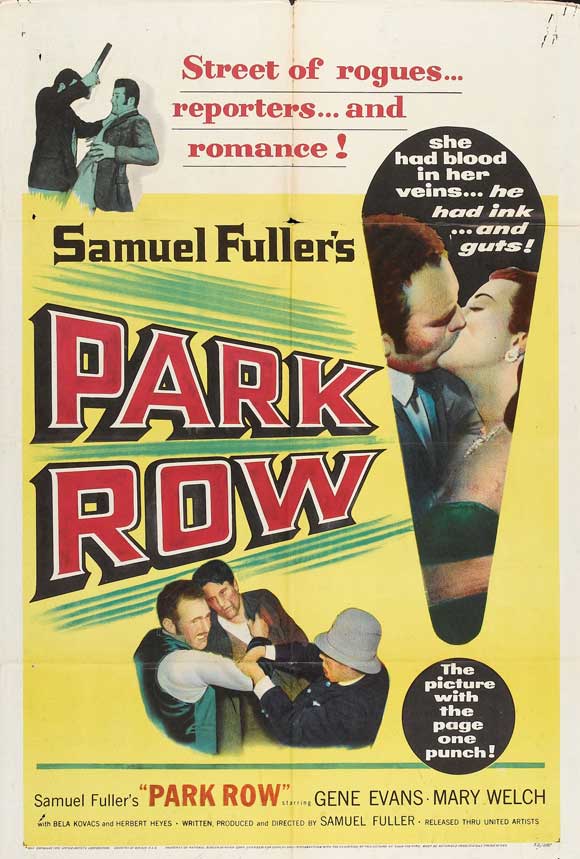
REVIEW – Park Row (1952)

FilmJuice have my review of Samuel Fuller’s classic film Park Row.

Set in 19th Century New York where dozens of newspapers are competing for dominance, Park Row tells the story of Phineas Mitchell… a reporter whose nose for a story and willingness to rattle cages results in him being sacked from one paper only to be given the editorship of another. The scene in which this professional transition takes place is telling as Mitchell is appointed as editor not because of his politics or his experience but because of the manifest greatness of his journalistic talent.  What makes this film so interesting is that while most films about journalism invoke the concept of journalistic greatness, many choose to define that concept in strictly moral terms: Did this journalist speak the truth? Did they change the world? Park Row, on the other hand, defines journalistic greatness in terms that are entirely amoral:

Unlike many odes to journalistic greatness, Fuller eschews both sentiment and morality in order to celebrate Mitchell’s ability to strike a chord and continue to play a tune regardless of how many people get crushed on the dance floor. Drawing freely from the press room cynicism of Citizen Kane’s opening act and pre-empting the vision of 19th Century New York as a bubbling cauldron of tribal violence in Martin Scorsese’s Gangs of New York, Fuller praises a form of journalistic greatness that the newspaper business is now only too eager to forget. Mitchell’s greatness is not that of Bernstein and Woodward in Alan J. Pakula’s All the President’s Men or that of Edward R. Murrow in George Clooney’s Good Night, and Good Luck, this is the greatness of Orson Welles’s Kane, Rupert Murdoch and Robert Maxwell. A form of greatness measured not in moral victories but in blood and gold… the type of greatness that builds industries and nations at the expense of individuals… the type of greatness that built America.

Made entirely with Fuller’s own money, Park Row is not just a love letter to journalism, it is a love letter to a sharp-edged and chaotic form of life that has now been excluded from the middle-class existential vocabulary.  Mitchell is neither a sharp-elbowed careerist or a shabby paladin, he is a brutal and energetic man who prowls through life with all the malignant pugnacity of a tiger with tooth-ache. This is a man who demands ‘Truth’ and ‘Liberty’ in much the same way as he might turn on you in order to demand ‘Did you just spill my pint?’. When Mitchell feels professionally marginalised, he starts his own newspaper. When Mitchell needs a story, he throws someone in jail in order to mount a campaign to secure their liberation. When Mitchell feels hard-done by, he takes to the streets and begins rioting. It is hardly surprising that many people have pointed out that Phineas Mitchell bears a striking resemblance to the cigar-chewing Fuller himself.

REVIEW – Jeff, Who Lives at Home (2011)

FilmJuice have my review of Jay and Mark Duplass’s indie dramedy Jeff, Who Lives at Home.

A little while ago, I wrote a piece giving full vent to my growing feelings of frustration with US ‘independent’ film. Once a home to quirky and insightful comedy-drama hybrids, US independent film is now a highly formulaic cultural space where directors make and re-make the same films over and over again while Hollywood A-listers grub for awards by pretending to be normal people with normal problems. However, as much as I felt that Reitman’s Young Adult was a retread of an already overly-familiar path, Jeff, Who Lives at Home is possibly the most generic film of all time:

Packed with stock characters wandering through the kind of character arcs that grace dozens of other films, the Duplass brothers deliver the achingly familiar in a style that is as safe as it is forgettable. In fact, this film’s characters are so recognisable that one cannot help but feel deprived of the actors that are usually typecast in these particular roles. For example, Segel is as likeable here as he was in Forgetting Sarah Marshall but his turn as a rudderless geek with a heart of gold lacks the satisfying bedrock of anger and self-loathing that the likes of Seth Rogen and Jonah Hill usually bring to this character type. Similarly, Helms’ Pat is a gruff pepper pot of squabbling neuroses but his charmless irritability does nothing but remind us of the profound humanity that allowed Paul Giamatti to effectively monopolise this type of part.

The worst thing about this film is that on the margins of the plot, partly obscured by white middle-class males ‘learning’ and ‘growing’, is a beautiful sub-plot featuring Susan Sarandon as a woman who, in late middle-age, comes to realise that what she really needs to make her happy is a sexless love affair without another straight woman. Both a much needed response to the growth in bromance movies and an amusing nod to the sexless love of Thelma and Louise, this sub-plot really does merit its own film. Fuck generic white guys, give me non-heteronormative middle-aged women!

REVIEW – Total Recall (1990)

FilmJuice have my review of Paul Verhoeven’s Total Recall. The review is of the freshly released and genuinely fantastic Blu-ray release of the film and it ties in quite nicely with this recent piece I also wrote for FilmJuice about the films of Paul Verhoeven.

The first thing that struck me about this film was how violent and sexually explicit it is by the standards of contemporary big budget filmmaking. Indeed, the likes of Michael Bay will frequently include women draped decoratively across motorbikes or ascending stairs but the actual sexual content of their films is practically non-existent. The reason for this is two-fold: A) These big budget films have absolutely immense budgets and in order to maximise their profitability, they need to be accessible to as wide an audience as possible. Hence the death of the ’18’ rated action film that dominated much of my childhood. B) The target demographic for most contemporary action films is teenaged boys whose sexual experience is usually limited to ogling and giggling… so whenever Bay has an actress bend over but not actually have sex with anyone, he is attempting to position his film in the sexual universe of horny teenaged boys. Compared to contemporary action films, Total Recall comes across as not only quite explicit but also quite surprisingly adult… particularly strange is the weird sexual energy that fizzes between the characters of Schwarzenegger and Stone as they beat each other up and pretend to be married:

One particularly wonderful element of the film is the relationship between Schwarzenegger’s violently bulging everyman and Sharon Stone’s pouting secret agent. Indeed, Stone plays the roll of a woman who is either a loving wife to Schwarzenegger or deep-cover operative assigned to keep him under surveillance lest his secret identity as a Martian freedom fighter begin to reassert itself. Rather than pitting these two personae against each other and musing as to which is the ‘real’ one, Verhoeven simply runs them together meaning that Stone’s character comes across as a lovingly traitorous wife who wants to kill her husband and have sex with him, quite possibly at the same time. Victims of actual domestic abuse might squirm as Schwarzenegger and Stone flit between flirting and kicking each other across the room but Verhoeven fully embraces the tension and presents it almost as a form of sadomasochistic play. Tellingly, when Schwarzenegger decides that he can no longer trust his wife, Stone’s character makes one last attempt to win him over by offering to let him tie her up. Verhoeven’s bizarre sexualisation of domestic abuse is both intensely unsettling and utterly compelling.

Total Recall is an excellent film and this Blu-ray edition does it proud.  Definitely worth revisiting and re-appraising.

The Films of Paul Verhoeven

FilmJuice have just uploaded a piece I wrote for them about the films of Paul Verhoeven, director of Robocop, Total Recall, Showgirls and Basic Instinct.

Regular readers of this site will know that I have a marked fondness for unpopular blockbuster directors like Neveldine/Taylor, Michael Bay and Zac Snyder. Part of what drives my fondness for these directors is their willingness to set aside human values in pursuit of absolute spectacle. All of these directors use violence and action to entertain their audiences but they also use sexuality and fascistic imagery in a way that many directors are reluctant to do. My view on these directors is that one cannot defend Big Dumb Blockbusters like Avengers or Spiderman whilst turning one’s nose up at films like Transformers 3. Summer blockbusters are in the business of pushing buttons and to have your buttons pushed is an inherently dehumanising process. The difference between directors like Bay and directors like Spielberg is that Bay is completely unapologetic about what it is that he does. He makes films for the sweaty masturbating homunculus in all of us:

When people talk about blockbuster action movies, their minds naturally gravitate to the works of sexless man-children such as Peter Jackson, Stephen Spielberg and George Lucas. The reason for this strange cognitive bias is that most people feel ashamed about watching big dumb action movies and so they need their violence to be not only bloodless but also presented in terms of absolute moral simplicity. Spielberg always cuts to the heroic working-class dad because cinema audiences need to know that their yearning for cinematic carnage does not make them a bad person. Similarly, George Lucas can neither shoot nor write a love scene because you can’t have people falling in love and then shooting each other in the face. That simply would not do.

My take on Paul Verhoeven is that he is a transitional figure in the history of blockbuster filmmaking as he spent the late 80s and early 90s building up mainstream audiences’ tolerance for sex. Without Verhoeven, people would never have gone to see Snyder’s Watchmen or Bay’s Transformers.

Prometheus (2012) – Calvinball Mythology and the Void of Meaning

0. We Crave Mythologies, Not Stories

Humanity has always told and listened to stories. Given that these stories sometimes provide the backbone for an entire culture or mode of being, it is only natural that stories should evolve to suit the needs of the cultures that tell them. Western culture has changed a lot over the last fifty years and one of the ways in which our culture has changed is that we have acquired a taste for longer and longer stories. Once upon a time, we watched films, read novels and enjoyed TV shows that could be watched in almost any order. Now, we read series of novels, watch trilogies of films and feel cheated if our TV series do not end by paying off storylines that span multiple seasons and dozens of episodes. As a culture, Westerners no longer crave stories… they crave mythologies.

While explanations for this trend towards narrative expansiveness may lie beyond the scope of a single blog post, I would suggest that we crave fictional mythologies because the religious mythologies we inherited have lost all credibility and the market has stepped in to fill the gap. Though we may not believe in the mythologies of Marvel comics in the same way that our parents believed in God, the experience of engaging with escapist literature is very similar to that of engaging with religious text.  As J.R.R. Tolkien once put it:

It is the mark of a good fairy-story, of the higher or more complete kind, that however wild its events, however fantastic or terrible the adventures, it can give to child or man that hears it, when the ‘turn’ comes, a catch of the breath, a beat and lifting of the heart, near to (or indeed accompanied by) tears, as keen as that given by any form of literary art, and having peculiar quality.

This ‘turn’ comes in the form of the moment when we suddenly lose ourselves in a fictional world and cheer inwardly when the narrative logic of that world asserts itself upon the events of the plot. When a hero finally wins the day or the tragic queen finally dies, we feel a sense of consolation that is entirely lacking from the ‘real world’ we inhabit for much of our waking lives. This desire to feel that the world abides by the rules of a story and that everything in the world happens for a reason is central to the religious impulse. Even a staunch Catholic like Tolkien recognised that the sense of fulfilment we gain from a good piece of escapist literature offers a faint echo of the sense of fulfilment that can be gained from having Faith in the Christian story.

As Westerners have come to demand more and more from their escapist media, creators have responded by not only satisfying those desires but by encouraging them whenever possible. These days, one cannot have a successful film without a franchise and one cannot have a franchise without a suite of media tie-ins including novels, games, TV series and comics. Each of these spin-offs adds complexity to the franchise and allows for the creation of yet more products whose worlds intersect that of the core franchise. The talent, manpower and money poured into the construction of these trans-media megatexts would be horrifying were it not so historically familiar… The truth is that our culture builds media franchises for the same reason that the Ancient Egyptians built pyramids and Medieval Christians built cathedrals: We are taking the fantastical and making it concrete so as to make the fantasy feel more like reality.

Continue reading →

REVIEW – The Island of Lost Souls (1932)

FilmJuice have my review of Erle C. Kenton’s much under-loved The Island of Lost Souls starring Charles Laughton and Bela Lugosi.

The film is a product of the 1930s Golden Age in American horror that produced many of the great American movie monsters. Based on H.G. Wells’ The Island of Doctor Moreau, The Island of Lost Souls was banned in the UK because of its tendency to deny God and play with the idea of inter-racial and inter-species sex. Indeed, to say that this film is racist would be something of an understatement as it represents an almost flawless articulation of White America’s fear that non-whites will someday rise-up and, in the immortal words of Hunter S. Thompson, savagely penetrate every orifice in their bodies with their throbbing, uncircumcised members:

The film’s use of the word ‘native’ to denote the man-beasts is hardly accidental as it panders to double-edged racist fantasies about non-white people being more animalistic than American Christians. I use the word ‘fantasies’ advisedly as this belief in the passionate nature of non-white people extends not just to their perceived capacity for violence but also to their atavistic sexualities. Thus, when Parker kisses Lota and recoils in disgust, his disgust is born not only of inter-racial and inter-species revulsion but also from the realisation that he enjoyed kissing the savage far more than he did his immaculate groomed white fiancée.

Interestingly, the film is currently considered to be out of copyright meaning that you can watch it for free on Youtube. However, the good folks at Eureka have done a fantastic job of packaging the film up with a series of interviews and essays and the print used for their release is fantastically clear so I definitely recommend picking up their edition rather than watching it for free on the internet.

REVIEW – Manhunter (1986)

THE ZONE has my review of Michael Mann’s recently re-issued psychological thriller Manhunter.

To put it simply, I adore this film. I adore the moody electronic score, I adore Dante Spinotti’s ridiculously colourful cinematography and I adore the way that Michael Mann lines up his shots. However, what I particularly love about this film is the way that it treats the character of Hannibal Lecter as a painstakingly-repressed dark side rather than a scenery-chewing panto dame:

 When Graham visits Lecktor in the hospital, we are told it is because he is hoping to rekindle the creative fires that allow him to project himself into the mind of a killer. However, rather than simply visiting Lecktor in the hospital, Graham reaches out to the disgraced psychiatrist in the hope that his superior understanding of human nature might shed some new light on the case. This act of deference to Lecktor’s superior expertise is deeply troubling when considered alongside Mann’s cinematic blurring of the line between psychologist and psychopath. Indeed, by having Graham turn to Lecktor as part of his own creative process, Mann seems to be suggesting the existence of a symbiotic relationship between the two men. In fact, one could interpret the scene as a sort of vision quest in which the creatively frustrated Graham turns to his painstakingly repressed dark side in order to unblock the empathic powers that will allow him to solve the case.

Mann’s take on Lecter is particularly fascinating as this film was adapted from Thomas Harris’s novel Red Dragon (1981) before Harris even wrote The Silence of the Lambs. In other words, this is a vision of Red Dragon that is completely untainted by the decision to reinvent Lecter as some kind of brain-eating antihero. Released on an absolutely flawless Bluray that makes it look like a brand new film, this re-issue offers an excellent opportunity to rediscover one of the best and most under-rated psychological thrillers of all time.

REVIEW – The Ledge (2011)

FilmJuice have my review of Mathew Chapman’s jaw-droppingly awful The Ledge.

The fact that The Ledge got made at all offers an interesting insight into the difference between British and American attitudes towards religion. For example, despite having an official state church and being an ostensibly Christian nation, British society is now so profoundly secularised that atheism is now our cultural default. In other words, when you meet someone new you do not automatically assume that they are a Christian. Instead, you assume that they are either an atheist, an agnostic or sufficiently non-religious that you do not need to worry about offending Christian sensibilities in casual conversation. In fact, British society is now so profoundly secularised that many intelligent atheists are becoming annoyed at the shrill combativeness of the so-called ‘New Atheists’, thereby creating a market for books that embrace a less confrontational form of atheistic thought. America, on the other hand, is still a de facto Christian nation. This is evident from the fact that politicians tend to speak in explicitly Christian terms while even the more outlandish Christian beliefs are seen as serious moral positions. Simply stated, no British person would think to make a film like The Ledge because British public discourse has effectively banished the more outlandish Christian beliefs meaning that the confrontational attitude of the New Atheists comes across as bullying and uncouth.

Even more problematic is the fact that The Ledge is not the film it purports to be:

Despite ostensibly resembling a thriller, The Ledge is actually quite a talky and slow-paced film constructed around a series of set pieces in which characters deliver extended speeches for and against a belief in God. Given that Chapman places so much emphasis on these speeches it seems safe to assume that The Ledge is intended to be a film about ideas. Unfortunately, Chapman’s attempt to make a film about the clash between atheism and religion fails on two levels: Firstly, none of the ideas contained in The Ledge are particularly new or profound. In fact, the characters of Gavin and Joe are so unsympathetic and intellectually stilted that it rapidly becomes clear that Chapman has just as little insight into atheism as he does into religious fundamentalism. Instead of providing us with well-rounded characters and thought-provoking ideas, Chapman delivers banal caricatures filled with nothing more than hot air. Secondly, despite bloating the film’s running time and draining the thriller elements of all urgency and tension, the polemical aspects of the film are so poorly integrated into the plot that they seem more like a distraction than a primary focus. Look beyond the PR guff about ideas and The Ledge reveals itself to be little more than a squalid melodrama about a traditional love triangle.

Even more problematic is that, once you strip away all the God-talk, The Ledge is revealed to be a deeply misogynistic piece of filmmaking. At the heart of the film is a confrontation between two individuals who are so convinced of their moral and psychological superiority that they feel utterly entitled to the love of a beautiful woman. Indeed, while Joe dominates Shana by dragging her to a series of increasingly repressive churches, Gavin dominates her using mind games designed to make her fall in love with him. The Ledge is a profoundly misogynistic film because both forms of domination not only succeed but also go completely unchallenged by a director who refuses us all access to Shana’s thoughts and feelings. Denied both agency and meaningful self-expression, the character of Shana is nothing more than an empty vessel for the desires of selfish and hateful men. Time and again, Shana is given the opportunity to speak up for herself but instead Tyler simply stares impassively into the camera like a beautiful doll whose sole purpose in life is to be owned by an alpha male.

The Ledge is easily one of the worst films I have seen this year. Now that the scars have begun to heal on the viewing experience, I am almost tempted to say that the film is ‘so bad it’s good’ but then I think about the scene in which the atheist crows about getting Liv Tyler’s character to masturbate while thinking about him and I’m reminded that this is nothing more than a dull and misogynistic piece of pseudo-intellectual garbage.

REVIEW – Corman’s World: Exploits of a Hollywood Rebel (2011)

The good folk at FilmJuice have my review of Alex Stapleton’s documentary Corman’s World.

Corman is an interesting figure in the history of American film as he appeared at a time when the American film industry was very slow to react to the cultural needs of the post-War generation. By remaining attuned to the desires of the babyboom generation, Corman managed to bootstrap himself first into commercial success and then into a certain degree of artistic respectability:

One of the most poignant moments in Corman’s World sees Martin Scorsese and Peter Fonda reminiscing about Corman’s willingness to fund films such as The Trip and The Wild Angels. Filled with psychotropic imagery and language lifted from Vietnam War demonstrations, these films not only gave younger people a voice, they also laid the foundations for such ground-breaking films as Easy Rider. As people who rose to prominence on the back of the 1960s, both Fonda and Scorsese seem perplexed as to why Corman never followed them out of the drive-in and into the academy but this is because both men seem to have mistaken Corman for an idealistic filmmaker. Despite trying his arm at politically engaged filmmaking, Corman was never an idealist… he was a democrat and a capitalist who gave his audience idealism because that is what they wanted to pay for. The unease we feel about Corman’s willingness to pander to his audience is the same unease we feel about Hollywood as a whole: are they making art or are they making money? The answer suggested by Stapleton is that they are doing both because both activities involve telling people what it is that they want and need to hear.

Stapleton’s documentary is probably best understood as a companion piece to Peter Biskind’s book about the post-War movie brat generation Easy Rider, Raging Bulls: How the Sex-Drugs-and-Rock-‘n’-Roll Generation Saved Hollywood (2008). I say companion piece as Stapleton’s documentary leans quite heavily upon Biskind’s vision of a generation that stormed the barricades of Hollywood and launched successful careers before either collapsing into narcissistic self-indulgence or devoting themselves to selling toys. However, while Biskind’s book provides a deliciously unflattering portrait of that ‘golden’ generation of post-War filmmakers, Stapleton provides a far more enthusiastic picture of one of that generation’s most noted losers. Indeed, as I suggest in the above quote, Corman stood poised to become a ‘serious filmmaker’ but he somehow never made that transition and by the time he was in a position to capitalise on his success the likes of Lucas and Spielberg had pipped him to the post and convinced Hollywood that the future lay in pandering to audiences with multimillion-dollar B movies like Jaws and Star Wars.

How to Make An American ‘Independent’ Film

Once upon a time, the term ‘American independent cinema’ designated an approach to filmmaking that was personal in outlook, regional in sensibility and European in aspiration. The goal of the movement was to learn from the European Art House movement of the 1960s and apply those lessons to films that looked beyond shoot-em-ups and courtroom dramas to what it really meant to be an American in the 20th Century. While the movement produced a wide array of different films, it is best known for its most successful work: Stephen Soderbergh’s Sex, Lies, and Videotape (1989).

As Peter Biskind notes in Down and Dirty Pictures (2004), the astronomical amounts of money generated by Sex, Lies, and Videotape kicked off a boom period for American independent film. Suddenly, American indies were big business but in order for them to stay big business it was necessary to replicate that success over and over again. The film industry has always reacted to unexpected success by repetition and the success of American independent films were no exception to this and so a template began to emerge allowing studios to keep making the same films for the same audience over and over again.

Here is my guide to creating an American independent film:

Continue reading →