XCOM is NOT a Boss Fight

XCOMIt’s been a while since I’ve written anything about video games but the awesome group blog Arcadian Rhythms were kind enough to host a little something I wrote about the stylistic differences between the original UFO: Enemy Unknown and its recent re-make XCOM: Enemy Unknown.

The main thrust of my argument is that while the original UFO was an emotionally muted and ambiguous affair that conveyed its themes of cataclysmic social change and philosophical crisis using subtle shifts in tone and design, the new XCOMexplores this same set of themes using a stylistic palate that is not so much muted as it is hysterical:

XCOM resembles the Metal Gear Solid series in so far as its approach to narrative is as totalitarian as it is melodramatic. Rather than trusting their material and their audience to find one another in an organic fashion, the writers of XCOM drive home every beat and every emotion as hard as they possibly can. Where the original UFO allowed players to uncover the disconnect between terrifying world and bland corporate office on their own terms, XCOM displays humanity’s precarious position in every colour scheme, every piece of text and every poorly performed and written cut-scene.

Games like XCOM are the product of a creative environment in which there is no room for subtlety or nuance. Like advertisers and political demagogues, AAA game designers are convinced that the only way of making the audience care is by reaching into their heads and forcing them to do so. Once upon a time, game designers used certain top-down narrative techniques to break up the monotony of fighting the same three enemies over and over again. Now, game designers use variations on these same manipulative techniques to wring emotional responses from the same old poorly written stories.

The most worrying thing about this growing tendency towards melodramatic storytelling is that it is a trend that is playing out across pretty much all the major gaming platforms. A fantastic example of this emotional bloat is the difference between the beautifully low-key nihilism of Far Cry 2 and the racist power fantasies of the recently released Far Cry 3. Indeed, while Far Cry 2 had you wandering around killing people and getting progressively closer (both spiritually and geographically) to the nihilistic figure of The Jackal, Far Cry 3 presents this same journey as a sort of spiritual quest in which you become a sort of white Christ figure for a group of noble savages. As with UFO and XCOM, the two Far Cry games demonstrate a growing discomfort around nuance, subtlety and ambiguity. For the modern AAA game designer, a game does not have a message unless the message is spelled out in a reductive and simple-minded fashion.  This unease around ambiguity is beautifully apparent in what must be one of the most extraordinary interviews ever conducted.

John Walker of Rock Paper Shotgun interviews Far Cry 3‘s Jeffrey Yohalem and pretty much accuses him of making a game that is a white power fantasy aimed at 20-something White Americans. Yohalem denies this and bizarrely supports his denial by pointing to all of the story beats and tropes that would lead you to think that the game is a power fantasy:

The sex scene [at the midpoint] – first Jason is shooting at that gigantic monster. He kills the monster, and it jump-cuts to him orgasming with Citra! He’s firing sperm at this gigantic monster, and then suddenly he’s on this alter with Citra, having sex with her, and then he thinks he’s the leader of the tribe and makes the big speech, and it’s his power fantasy! That’s the other thing – it’s all from first-person, so it’s completely unreliable. There’s a reason why Jason is a 25 year old white guy from Hollywood – these are all ideas that are in his head. You’re seeing things through his eyes.

Clearly, Yohalem believes that he is being satirical and yet the game he has helped produce is absolutely indistinguishable from a non-satirical white power fantasy. In other words, while Yohalem may have intended to express ambivalence towards traditional video game narratives, the ambivalence simply did not carry across into the final game. The game is so busy trying to manipulate the audience’s emotions that it simply does not allow for the fact that the game might intend you to call these emotions into question. Yohalem points to a number of clues supporting his ironic interpretation of the game but all of these techniques are drowned out by the game’s desperation to make the player feel like a gosh-darned hero.

Melodrama is an entirely acceptable emotional register when the aim of the game is to engender an authentic emotional response to a particular text. Consider, for example, Luca Guadagnino’s majestic I Am Love (2009) starring Tilda Swinton:

The film tells the story of a woman who marries into a large Italian family. While this family provide the woman with a luxurious lifestyle, it also forces her to exist in a repressed emotional universe that requires her to be be the perfect wife at all times. However, this universe is shattered when the women meets a local chef who unlocks her emotional core and drags her into a whole new world. Let me be clear on this: I Am Love is one of my absolute favourite films; I think Guadagnino’s ability to use music, lighting, architecture and colour to create different emotional worlds is absolutely astonishing and when the woman finally breaks free from her old life, I wept openly in the cinema. I did this because Guadagnino is an absolute master at emotional manipulation.

The difference between I Am Love and Far Cry 3 is that while I Am Love is all about the authentic emotional experience of love, transformation and happiness, Far Cry 3 is supposedly about questioning the very emotions that the game evokes. Far Cry 3‘s problem is that while the aim of the game might have been to question white racial privilege, the style of the game celebrates white power fantasies in much the same way as I Am Love celebrates the transformative power of love. Melodrama is a tradition that allows the audience to experience what the characters are experiencing, it is not a tradition that encourages us to deconstruct our own emotional responses. On one level, it is tempting to simply dismiss Yohalem as a simpleton who doesn’t understand the concept of style but games like Far Cry 3 point to a far deeper problem, namely that AAA game designers are now so used to melodrama that they simply do not realise that there are other emotional registers that might better suit the stories they are attempting to tell.

REVIEW – Die Nibelungen (1924)

FilmJuice have my review of Masters of Cinema’s re-release of Fritz Lang’s fantasy epic Die Nibelungen.

Originally released in two halves as Die Nibelungen: Siegfried and Die Nibelungen: Kriemhilde’s Rache, the film spend five hours exploring the tension between the passions that drive society onwards and the rules developed to govern that society’s violent impulses and channel them into more productive pursuits such as the construction of a modern state governed by enlightened individuals. The film begins with a great hero making his way to what he assumes to be a shining city on a hill… a beacon of medieval civilisation in an ocean of blackness and savagery.  Upon arriving at the legendary city of Burgundy, the hero falls in love with the king’s sister but in order to gain the permission to marry Kriemhild, Siegfried must trick the hero Brunhild into marrying cowardly king Gunther. Brunhild eventually discovers the ploy and demands that Gunther redeem herself by killing Siegfried. Weak and afraid, Gunther convinces his chief knight to murder Sigfried prompting his sister Kriemhild to present him with an ultimatum: Either Gunther betrays his chief knight and does justice to Kriemhild or he remains loyal to his knight and ignores the injustice that keeps him on the throne.

Die Nibelungen is essentially the story of an immoral oyster pearl.  Though Gunther is the king of a great country his desire for the hero Brunhild prompts him into doing something immoral. Trapped in a lie, Gunther then adds to his woes by first murdering his friend and then turning his back on his beautiful sister who promptly runs off and marries the lord of the Huns in an effort to force her brother to do her justice. The more Gunther denies wrong-doing, the greater the injustice grows and the greater the injustice grows, the more transparently immoral the world becomes:

It is easy to see why both Adolf Hitler and Joseph Goebels claimed Die Nibelungen as one of their favourite films. Aside from the Germanic origins of the Nibelungen stories, Lang also draws heavily upon the idea that a group of blond-haired heroes might emerge from the common muck of humanity and, through sheer force of character, build a shining civilisation on a hill. Marinated in the same myths of national exceptionalism that informed the iconography of the Third Reich, Lang’s film presents the king of the Dwarves as a treacherous Jew and the emotional energies unleashed by Kriemhild at the end of the film as a tide of dark-skinned savages from the East. This is not just a film that is of its time, this is a film that perfectly captures a time when a society’s capacity to regulate its own behaviour can no longer cope with the violent forces at work in the culture at large. By refusing to constrain his feelings of lust for Brunhild, Gunther is forced to trick her into marriage, by refusing to discuss or atone for his dishonest seduction of Brunhild, Gunther is forced to murder his friend, by refusing to acknowledge that he had his friend murdered, Gunther is forced to go to war with his sister and by attempting to justify his actions through an appeal to loyalty, Gunther undermines the entire moral infrastructure of his society… there are no rules, there are no principles, there are no cities on the hill… there is only violence, lust, madness and death.

Lang’s Burgundian society reflects a German political culture that was finding it increasingly difficult to deal with intense feelings of anger and desire. Pickled in war resentment and drunk on a growing sense of historical self-importance, German culture burst its banks and drowned Europe in blood while German political elites either worked the crowd or went with the flow. Die Nibelungen‘s political elites use words like ‘honour’ and ‘loyalty’ but these words become increasingly meaningless as the film progresses.  Just as American political elites use words like ‘freedom’ and ‘patriotism’ to justify violence and repression, King Gunther uses the word ‘loyalty’ to justify the betrayal and murder of his brother-in-law. By distorting shared values in an effort to justify their own selfish desires, the royals of Die Nibelungen paint themselves into a political corner: fully aware that their war will lead to nothing but destruction, they can neither compromise nor make peace as the words required to broker a cease-fire have been rendered completely meaningless.

REVIEW: Giorgio Moroder Presents Metropolis (1984)

FilmJuice have my review of Giorgio Moroder’s eighties remix of Fritz Lang’s immortal Metropolis.

Lang’s Metropolis is a science fiction fairy tale dealing in class warfare, economic collapse and the power of compromise and understanding to deliver a world that is at the very least tolerable to all. Grounded in the cinematic techniques developed by German Expressionism to increase the bandwidth of silent film and unlock new depths of emotional complexity, the film is two and a half hours of directorial brilliance. However, though the original cut of the film has now been recovered, there were decades during which people believed it would never be seen again. Given that Metropolis is not only a beautiful but also an intensely important film, it was perhaps unavoidable that attempts to restore it would stir up strong feelings. In fact, the debate over what should be done with the Metropolis fragments rapidly coalesced into a bitter confrontation between those who wanted the original film left as it was and those who wanted the meddle with the footage in the hopes of recapturing some dim afterglow of Lang’s genius. Giorgio Moroder’s Metropolis is not only the best known and most interventionist of the alternate edits of Metropolis, it was also the most widely seen version of the film as the ‘hip’ scoring by eighties pop stars combined with the short running time ensured that copies of the film flew in and out of video rental stores throughout the eighties and nineties. Now that the original cut of the film has been recovered, it is tempting to simply consign Moroder’s edit to the bin and move on but this cut has historical merit on its own.

Moroder’s Metropolis is a short and punchy affair that feels very much like an extended trailer for original version of the film. Moroder solves the narrative problems of the various re-cuts by stripping out much of the dialogue and drama in order to focus upon the big cinematic set pieces and emotional moments. Somewhat unsurprisingly, this results in a film that bubbles with the same hysterical energy and visual spectacle as the Michael Bay Transformers movies. However, rather than leaving his characters to scream and flail about like Shia LaBoeuf, Moroder attempts to fill in the emotional gaps by scoring the film with a series of somewhat heavy-handed eighties power ballads performed by the likes of Bonnie Tyler, Freddy Mercury and Pat Benatar. Moroder also colourises the film in an attempt to convey changes of mood which, though obvious from the context of Lang’s longer film, struggle to emerge from the mangled cinematic vocabulary of the truncated versions.

Watching this film, I couldn’t help but wonder what other alternate edits of classic films are out there… the film is being re-released today by Masters of Cinema in a limited edition steel shell thingy. Release of the standard edition is coming later this year according to the Brazilian river place.

REVIEW – Total Recall (1990)

FilmJuice have my review of Paul Verhoeven’s Total Recall. The review is of the freshly released and genuinely fantastic Blu-ray release of the film and it ties in quite nicely with this recent piece I also wrote for FilmJuice about the films of Paul Verhoeven.

The first thing that struck me about this film was how violent and sexually explicit it is by the standards of contemporary big budget filmmaking. Indeed, the likes of Michael Bay will frequently include women draped decoratively across motorbikes or ascending stairs but the actual sexual content of their films is practically non-existent. The reason for this is two-fold: A) These big budget films have absolutely immense budgets and in order to maximise their profitability, they need to be accessible to as wide an audience as possible. Hence the death of the ’18’ rated action film that dominated much of my childhood. B) The target demographic for most contemporary action films is teenaged boys whose sexual experience is usually limited to ogling and giggling… so whenever Bay has an actress bend over but not actually have sex with anyone, he is attempting to position his film in the sexual universe of horny teenaged boys. Compared to contemporary action films, Total Recall comes across as not only quite explicit but also quite surprisingly adult… particularly strange is the weird sexual energy that fizzes between the characters of Schwarzenegger and Stone as they beat each other up and pretend to be married:

One particularly wonderful element of the film is the relationship between Schwarzenegger’s violently bulging everyman and Sharon Stone’s pouting secret agent. Indeed, Stone plays the roll of a woman who is either a loving wife to Schwarzenegger or deep-cover operative assigned to keep him under surveillance lest his secret identity as a Martian freedom fighter begin to reassert itself. Rather than pitting these two personae against each other and musing as to which is the ‘real’ one, Verhoeven simply runs them together meaning that Stone’s character comes across as a lovingly traitorous wife who wants to kill her husband and have sex with him, quite possibly at the same time. Victims of actual domestic abuse might squirm as Schwarzenegger and Stone flit between flirting and kicking each other across the room but Verhoeven fully embraces the tension and presents it almost as a form of sadomasochistic play. Tellingly, when Schwarzenegger decides that he can no longer trust his wife, Stone’s character makes one last attempt to win him over by offering to let him tie her up. Verhoeven’s bizarre sexualisation of domestic abuse is both intensely unsettling and utterly compelling.

Total Recall is an excellent film and this Blu-ray edition does it proud.  Definitely worth revisiting and re-appraising.

Calvinball Mythology: The Inevitable Follow-up Post

A couple of weeks ago, I wrote a piece about Ridley Scott’s Prometheus that allowed me to voice some ideas about the role of escapist media in contemporary spiritual life.  Evidently this post struck a chord with a good deal of people as I have been receiving a lot of traffic from people kind enough to link to me. While I cannot address all of the points raised by people, I can address a few of the comments that caught my eye.  Thank you all for your attention and I am delighted that you enjoyed the read!

Continue reading →

REVIEW – Howl’s Moving Castle (2004)

FilmJuice have my review of Hayao Miyazaki’s adaptation of Diana Wynne Jones’s Howl’s Moving Castle. Re-watching the film for the first time since it first appeared in a UK cinema, I was struck by the extent to which it is a microcosm for all the strengths and weaknesses of Miyazaki’s direction:  On the plus side, the animation is spectacular, the mood is uplifting without ever seeming false and the design is a profound expression of nostalgia for a sophisticated, metropolitan Europe that may never have existed in the first place. On the down side, the plotting is frequently nonsensical and the characters have so little depth that they struggle to command our interest, let alone our sympathies. As I put it in the review:

If you are one of those upper middle-class parents that have latched onto Miyazaki as a reliable source of non-violent and morally uplifting children’s entertainment then Howl’s Moving Castle is definitely the film for you. The animation, artwork and pacing are more than enough to keep the little ones amused while their parents sit in open-plan kitchens drawing up plans to take over a Tuscan bean farm or a gite in the Dordogne. However, if you are a grown-up looking for grown-up ideas and characters then Howl’s Moving Castle is a touch more problematic.

A couple of years ago, I wrote a piece about Miyazaki’s Ponyo (2008) in which I suggested that Miyazaki’s attitudes towards humanity moved back and forth between flesh-rending misanthropy and warm-hearted sentimentality. In that piece, I concluded that Miyazaki tended to ‘do’ warm-hearted sentimentality a lot better than he did complex adult morality. Having recently re-watched both Ponyo and Howl’s Moving Castle, I now realise that my earlier diagnosis was entirely off base. The problem is not that Miyazaki struggles with adult morality, it is that he struggles with human psychology but that these struggles are less evident when they are presented as part of a film aimed directly at children. Indeed, both Ponyo and Howl’s Moving Castle suffer from the fact that they are films that revolve around entirely unconvincing love stories but because Ponyo presents itself as child-friendly, we are more inclined to forgive its lack of psychological foundation while Howl’s Moving Castle seems much more grown-up and so the lack of real characterisation is both obvious and grating.

Prometheus (2012) – Calvinball Mythology and the Void of Meaning

0. We Crave Mythologies, Not Stories

Humanity has always told and listened to stories. Given that these stories sometimes provide the backbone for an entire culture or mode of being, it is only natural that stories should evolve to suit the needs of the cultures that tell them. Western culture has changed a lot over the last fifty years and one of the ways in which our culture has changed is that we have acquired a taste for longer and longer stories. Once upon a time, we watched films, read novels and enjoyed TV shows that could be watched in almost any order. Now, we read series of novels, watch trilogies of films and feel cheated if our TV series do not end by paying off storylines that span multiple seasons and dozens of episodes. As a culture, Westerners no longer crave stories… they crave mythologies.

While explanations for this trend towards narrative expansiveness may lie beyond the scope of a single blog post, I would suggest that we crave fictional mythologies because the religious mythologies we inherited have lost all credibility and the market has stepped in to fill the gap. Though we may not believe in the mythologies of Marvel comics in the same way that our parents believed in God, the experience of engaging with escapist literature is very similar to that of engaging with religious text.  As J.R.R. Tolkien once put it:

It is the mark of a good fairy-story, of the higher or more complete kind, that however wild its events, however fantastic or terrible the adventures, it can give to child or man that hears it, when the ‘turn’ comes, a catch of the breath, a beat and lifting of the heart, near to (or indeed accompanied by) tears, as keen as that given by any form of literary art, and having peculiar quality.

This ‘turn’ comes in the form of the moment when we suddenly lose ourselves in a fictional world and cheer inwardly when the narrative logic of that world asserts itself upon the events of the plot. When a hero finally wins the day or the tragic queen finally dies, we feel a sense of consolation that is entirely lacking from the ‘real world’ we inhabit for much of our waking lives. This desire to feel that the world abides by the rules of a story and that everything in the world happens for a reason is central to the religious impulse. Even a staunch Catholic like Tolkien recognised that the sense of fulfilment we gain from a good piece of escapist literature offers a faint echo of the sense of fulfilment that can be gained from having Faith in the Christian story.

As Westerners have come to demand more and more from their escapist media, creators have responded by not only satisfying those desires but by encouraging them whenever possible. These days, one cannot have a successful film without a franchise and one cannot have a franchise without a suite of media tie-ins including novels, games, TV series and comics. Each of these spin-offs adds complexity to the franchise and allows for the creation of yet more products whose worlds intersect that of the core franchise. The talent, manpower and money poured into the construction of these trans-media megatexts would be horrifying were it not so historically familiar… The truth is that our culture builds media franchises for the same reason that the Ancient Egyptians built pyramids and Medieval Christians built cathedrals: We are taking the fantastical and making it concrete so as to make the fantasy feel more like reality.

Continue reading →

There is no such thing as a Reliable Narrator

A recent issue of the London Review of Books contained a fascinating review of Hilary Mantel’s Bring Up the Bodies, sequel to her Man Booker Prize-winning novel Wolf Hall. One of the questions addressed in Colin Burrow’s review (which can be read here if you’re a subscriber) is that of whether Mantel is overly charitable in her depiction of Thomas Cromwell as a man with thoroughly modern sensibilities:

The crude question ‘Does this mean that he could have felt as much and as finely as he does in this book?’ still needs to be asked. The novel’s present-tense mode of narrative, focalised through a single principal character, has an intrinsic problem. It would be almost impossible to write this kind of fiction and make the central character a brute, since so much depends upon what he or she notices and feels, on sensitivity. If a fiction represents the sensorium of one character’s feelings, then an inert or insensitive sensorium would probably generate inert fiction.

To my mind, this is pretty much spot on. While I have not read Bring Up the Bodies, I have read Wolfe Hall and Mantel’s depiction of Tudor England is so fragrant and atmospheric that it simply could not have been filtered through the mind of a character who saw the world purely in terms of fights, political conquests or scientific problems in need of a solution. In order for Mantel to portray Tudor England as a place full of colour and contrast, she needed a central character who would be alive to those elements of his world. Had Cromwell been a brute, then he would have attended to brutish things and our impression of the Tudor England would have been immeasurably more brutish as a result.

This got me thinking… people often talk about characters in very instrumental terms, portraying them either as psychological riddles in need of decoding or as means of capturing the reader’s empathy and using that connection to immerse them in the world of the novel.  Indeed, people often talk about the possibility of novels having ‘unreliable narrators’ in the sense that some fact about the narrator might shed some doubt on his or her version of the facts and thereby encourage readers to infer some previously hidden truth about the events described in the novel. The problem with the concept of the ‘unreliable narrator’ is that it assumes that there can be a ‘reliable’ narrator but I do not see how this could possibly be.

When each of us walk into a room, our attentions are drawn to different things dependent upon our perceptual capacity, our life experience, our personality, our interests and our mood. Two people can walk into exactly the same room and their minds will turn to very different matters: One will notice a social rival and begin speculating about how they can confront and humiliate them while another will begin to internally enthuse about the style of dress and the quality of the food. In this case both narrators are, strictly speaking, unreliable as the picture they give of a particular situation is incomplete and slanted… but how else are we to perceive the world except through our eyes, our experiences and our personalities?

A little while ago, I wrote about Jo Walton’s Hugo Award-nominated novel Among Others (2011) and commented on how cold and emotionally detached the world of that novel felt to me. Given that, much like Wolf Hall, Among Others focuses upon the life and experiences of one particular character, I inferred that much of the coldness of the world came from the fact that the book’s narrator was some kind of psychopath:

The work whose tone and setting most closely match that of Among Others is Orson Scott Card’s Ender’s Game (1985) as Mor is not only isolated and alienated but also intensely calculating in her relationships with other people. There are scenes where Mor discusses purchasing buns for other girls on the understanding that this will get them to buy her buns in return that echo with the same sociopathic lack of humanity as the scenes in which Ender ponders murdering or brutalising a bully in order to set an example.

Among Others and Ender’s Game are perfect examples of the kind of book that Burrow speculates must exist: They are emotionally inert because their central characters are themselves emotionally inert. The same can be said of Steve McQueen’s second film Shame (2011), which is cold, austere and minimalistic because its central character lives a life that is just as uncluttered as his elegantly-designed Manhattan apartment.

The ‘take home’ point from all of this is that characters are not solely defined by the things they think or the things they do, they are also defined by the things they pay attention to. Any novel that uses first-person narration or clings closely to a third-person viewpoint character must necessarily be read as that character’s subjective impression of the world they inhabit. While all of us share the same physical world, we live our lives in subjective universes built to suit our preferences. The art of great writing lies not just in making a character or a world that seems realistic, but in exploring the way in which the world makes the character and the character makes their own world.

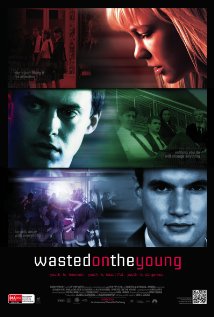
REVIEW – Wasted on the Young (2010)

THE ZONE has my review of an interesting Australian film by first-time director Ben C. Lucas. Wasted on the Young is stylishly shot high school mystery in very much the same tradition as Rian Johnson’s Brick. Aside from the intriguing plot and the deliciously chilly cinematography, what really grabbed me about this film was its attempt to get inside the head of contemporary teenagers whose every move is recorded by CCTV cameras and whose every thought is captured by social media:

 As William Gibson’s recent writings have suggested, there was a point when society changed and certain ideas ceased to be science fictional. Yesterday’s cyberpunk futurism is today’s kitchen sink realism. Similarly, many old realist touchstones appear to be little more than genre affectations tainted by reactionary nostalgia. We no longer live in a world where women can afford to be bored doctor’s wives. Virginia Wolfe once described George Elliott’s Middlemarch as one of the few British novels written for adults but when read today, the book appears about as realistic as a quest to destroy a magical ring. By borrowing elements from the hard-boiled and cyberpunk genres while simultaneously downplaying the fictional character of these elements, Lucas is attempting to capture what it feels like to grow up in a world with its own set of realist touchstones and its own set of worries and concerns.

Watching it I was reminded not only of the more recent works by William Gibson but also the short stories of Tim Maughan (some of which I reviewed a little while back). What unites these works is a realisation that, rather than simply adding to an already existing world, the internet and social media are changing the world by sculpting how young people learn to see and react to the world. Literary theorists have spent the last 100 years bemoaning the fact that we are now modern and as such have severed our ties to the gods of our forefathers. Similarly, transhumanists spend much of their time banging a drum for the change that will come with the arrival of the Singularity. The more I read and the more I think about today’s youth, the more I realise that there is no great Death of Pan or Birth of the Singularity… there’s just some old fucks dying and some young fucks taking their place. Society is in constant evolution and social media is one particular area of genetic drift. In 10 years (let alone 100), people will wander what it was like to live without the internet and so any work of art that does not engage with the social changes created by the internet must be seen as little more than a side-show.

Gibson’s decision to re-position himself as a mainstream writer rather than a genre writer is the product of two forms of change: Firstly, society has changed to the point where science-fictional ideas are now realistic ideas. Secondly, Gibson needed to leave genre because genre has no interest in writing about the world that we are currently making for ourselves. Wasted on the Young is yet more evidence that science fiction has run its course as both a literary tradition and a sub-culture as it is easily as cyberpunky as any of Gibson’s recent novels and yet it presents these scientific and social ideas as nothing more than grindingly mundane realism.

REVIEW – Yatterman (2009)

My review of Takashi Miike’s Yatterman has just gone live over at FilmJuice.

Wheeled out as part of an attempted relaunch of a children’s anime franchise from the 70s, Yatterman is absolutely fantastic to look at: The design is sensational, the special effects superb and the action sequences flawless. Most interesting of all is the fact that Miike did not feel in anyway compelled to ‘darken’ the source material as Western directors have insisted on doing when adapting video games and comics. Of course, this ‘darkening’ betrays a deep-seated distrust of the source material; comics and video games are not a fitting subject matter for film and so any attempt to adapt them for the screen must go out of its way to appear ‘mature’ and ‘series’ even when it is nothing of the sort. As a result of this refusal to betray the source material, Yatterman is delightfully bright and poignantly childish… I mean, the opening scene sees a giant robotic chef fighting a giant robotic dog. Grimdark this ain’t. However, while this is all very interesting from a design point of view, it does not make for a particularly interesting film as the characters and plots are taken directly from the source material and 70s children shows are not known for their robust characterisation. Even in Japan.

The only thing preventing Yatterman from being completely unwatchable is Miike’s decision to present the characters as brightly-coloured cartoons that secretly yearn for a normal adult life:

Furthermore, the film suggests a similar tension between adult sexuality and bawdy anime-style humour. Indeed, when perverted baddy Boyacky (Namase) reveals his innermost desire to possess all the schoolgirls of Japan we assume his desire to be sexual in nature. However, when we cut to the inside of Boyacky’s fantasy we learn that he desires nothing more than to paint their toes. Thus, the man who spends the entire film leering down cleavages, peeking up skirts and drooling at unexpected nudity is revealed as being so sexually stunted and emotionally immature that he literally cannot imagine himself having actual sex with another human being.

In other words, either you spend your time leering at moe figurines or you get to have proper sex with people. You can’t have it both ways. Given that the anime attached to this film is filled with fanservice and that the film itself was presumably financed on the assumption that it would pander to otaku, you have to salute Miike’s bravery. Even Michael Haneke never went so far as to call his audience a pack of emotionally stunted virgins.