I Saw the Devil and His Name Was Kim Jong-un – Vengeance and South Korean Cinema

Kim Ji-woon’s I Saw the Devil tells of a South Korean intelligence agent who responds to the death of his wife by tracking down the man who murdered her. However, instead of simply killing the man, the agent decides to install surveillance equipment that will allow him to continue punishing the murderer over an extended period of time. Initially, the killer is taken aback by the agent’s hatred but he soon comes to enjoy the confrontations and so lures the agent into an increasingly brutal contest of wills. Hideously violent, unflinchingly brutal and yet beguiling to watch, Kim’s film offers a traditionally Nietzschean warning to those who would consider embarking on a quest for revenge:

Battle not with monsters, lest ye become a monster, and if you gaze into the abyss, the abyss gazes also into you.

While Kim’s film is beautifully made and eminently entertaining, I cannot help but wonder why it is that he felt inspired to make a film with this particular message. Back in 2005, Kim directed the wonderful A Bittersweet Life in which the protagonist exacts a bloody revenge on his employers for the way in which they deprived him of a personal life and yet responded with furious anger the second he stepped out of line in an effort to grab some happiness for himself. Given that A Bittersweet Life convincingly communicates the idea that revenge is a necessary but ultimately self-defeating course of action, it is strange to see Kim making yet another film with this precise message. Especially when the message in question is so blindingly obvious that it scarcely merits a passing thought at all let alone enough thought to fill two entire films. Even more puzzling is the fact that Kim is not alone in his desire to brood over the morality of vengeance. In fact, South Korean cinema has produced so many revenge films in recent years that one can comfortably talk about them constituting a sub-genre in their own right.

Continue reading →

A Paragraph from Peter Straub’s Ghost Story

Last night I picked up my copy of Peter Straub’s Ghost Story (1979) and just started reading. Within a couple of pages, I pulled up short, unable to get past the astonishing beauty and craft of this paragraph:

So for hours they drove south through the songs and rhythms of country music, the stations weakening and changing, the disk jockeys swapping names and accents, the sponsors succeeding each other in a revolving list of insurance companies, toothpaste, soap, Dr Pepper and Pepsi Cola, acne preparations, funeral parlors, petroleum jelly, bargain wristwatches, aluminum sidings, dandruff shampoos: but the music remained the same, a vast and self-conscious story, a sort of seamless repetitious epic in which women married truckers and no-good gamblers but stood by them until they got a divorce and the men sat in bars plotting seductions and how to get back home, and they came together hot as two-dollar pistols and parted in disgust and worried about the babies. Sometimes the car wouldn’t start, sometimes the TV was busted; sometimes the bars closed down and threw you out onto the street, your pockets turned inside out. There was nothing that was not banal, there was no phrase that was not a cliché, but the child sat there satisfied and passive, dozing off to Willie Nelson and waking up to Loretta Lynn, and the man just drove, distracted by this endless soap opera of America’s bottom dogs.

The thing that strikes about this paragraph is the way that it breaks down into three very different sentences. The first – which MS Word is currently underlining entirely in green – is not just a run-on sentence but a run-on sentence comprising little more than a list of things overheard on the radio. Aside from Straub’s eye for set dressing (The South belongs to Dr Pepper and Pepsi… not Coke), the astonishing thing about this sentence is that it in no way feels over-long or under-punctuated. It is easy to forget that punctuation exists in order to instruct the reader where to place emphasis and when to pause while reading ‘aloud in their head’. Straub strings his sentence together using a series of commas and a semi-colon that shifts the emphasis away from the adverts and towards the music. The sentence does not feel too long because Straub chooses his words with utmost care and precision. He chooses them for colour and he chooses them for cadence. He chooses them places them in the sentence in a very specific order so as to ensure that we can read the entire sentence without ever getting lost and without ever having to check the punctuation to make sense of what it is that we have just read. The words and concepts slip by us like the miles of a cross-country road trip. They fit together because we see them together, their association is almost accidental and yet strangely evocative in the same way that shopping trolleys and broken windows create an impression of poverty that has little to do with the bank balances of local residents. The semi-colon is a masterstroke as it changes the emphasis without jerking us out of the rhythm of the sentence. Once it was adverts that flowed by us, now it is song lyrics. They flow into one another and create a single impression almost by accident but seemingly by design.

If the semi-colon was impressive then the full stop is a stroke of genius. Again, we are confronted by a list of things but Straub cleverly inserts the second-person pronoun ‘You’ to suggest a growing bond between the music and the listened. What began as a way to keep the child quiet ends as a reflection on the listener’s life. YOU know what it’s like to be thrown out of a bar. YOU know what it’s like to have a busted TV and nothing to do. YOU know these things and so do the singers and songwriters. They speak to YOU, their words are no longer just a different type of noise to the adverts that started the paragraph. They got to YOU.

The third sentence finds the listener jerking himself out of a country music-filled reverie. The opening clause of the sentence is almost petulant: “There was nothing that was not banal, there was no phrase that was not a cliché” then comes the comma… then comes the BUT. This shit is awful, trite, clichéd nonsense but it lulled the child to sleep and it gave the miles a pleasing feel. Just enough of a pleasing feel to allow the driver to forget that the child on the back-seat has been abducted and that, sooner or later, he will have to be deal with her one way or another. That time will come… but not yet: “the man just drove, distracted by this endless soap opera of America’s bottom dogs.”

Even those last two words are brilliant: Bottom Dogs… Buh-dum Dah!

REVIEW – The Island of Lost Souls (1932)

FilmJuice have my review of Erle C. Kenton’s much under-loved The Island of Lost Souls starring Charles Laughton and Bela Lugosi.

The film is a product of the 1930s Golden Age in American horror that produced many of the great American movie monsters. Based on H.G. Wells’ The Island of Doctor Moreau, The Island of Lost Souls was banned in the UK because of its tendency to deny God and play with the idea of inter-racial and inter-species sex. Indeed, to say that this film is racist would be something of an understatement as it represents an almost flawless articulation of White America’s fear that non-whites will someday rise-up and, in the immortal words of Hunter S. Thompson, savagely penetrate every orifice in their bodies with their throbbing, uncircumcised members:

The film’s use of the word ‘native’ to denote the man-beasts is hardly accidental as it panders to double-edged racist fantasies about non-white people being more animalistic than American Christians. I use the word ‘fantasies’ advisedly as this belief in the passionate nature of non-white people extends not just to their perceived capacity for violence but also to their atavistic sexualities. Thus, when Parker kisses Lota and recoils in disgust, his disgust is born not only of inter-racial and inter-species revulsion but also from the realisation that he enjoyed kissing the savage far more than he did his immaculate groomed white fiancée.

Interestingly, the film is currently considered to be out of copyright meaning that you can watch it for free on Youtube. However, the good folks at Eureka have done a fantastic job of packaging the film up with a series of interviews and essays and the print used for their release is fantastically clear so I definitely recommend picking up their edition rather than watching it for free on the internet.

REVIEW – Manhunter (1986)

THE ZONE has my review of Michael Mann’s recently re-issued psychological thriller Manhunter.

To put it simply, I adore this film. I adore the moody electronic score, I adore Dante Spinotti’s ridiculously colourful cinematography and I adore the way that Michael Mann lines up his shots. However, what I particularly love about this film is the way that it treats the character of Hannibal Lecter as a painstakingly-repressed dark side rather than a scenery-chewing panto dame:

 When Graham visits Lecktor in the hospital, we are told it is because he is hoping to rekindle the creative fires that allow him to project himself into the mind of a killer. However, rather than simply visiting Lecktor in the hospital, Graham reaches out to the disgraced psychiatrist in the hope that his superior understanding of human nature might shed some new light on the case. This act of deference to Lecktor’s superior expertise is deeply troubling when considered alongside Mann’s cinematic blurring of the line between psychologist and psychopath. Indeed, by having Graham turn to Lecktor as part of his own creative process, Mann seems to be suggesting the existence of a symbiotic relationship between the two men. In fact, one could interpret the scene as a sort of vision quest in which the creatively frustrated Graham turns to his painstakingly repressed dark side in order to unblock the empathic powers that will allow him to solve the case.

Mann’s take on Lecter is particularly fascinating as this film was adapted from Thomas Harris’s novel Red Dragon (1981) before Harris even wrote The Silence of the Lambs. In other words, this is a vision of Red Dragon that is completely untainted by the decision to reinvent Lecter as some kind of brain-eating antihero. Released on an absolutely flawless Bluray that makes it look like a brand new film, this re-issue offers an excellent opportunity to rediscover one of the best and most under-rated psychological thrillers of all time.

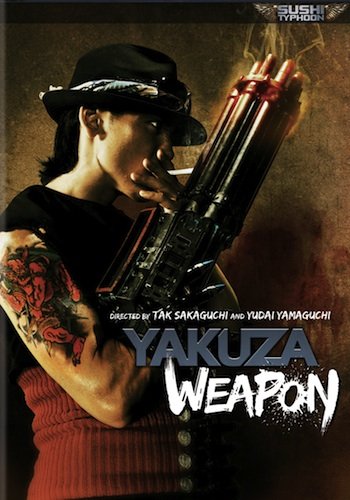
REVIEW – Yakuza Weapon (2011)

THE ZONE has my review of Tak Sakaguchi and Yudai Yamaguchi’s muddled and disappointing Yakuza Weapon.

The film presents itself partly as a genre spoof and partly as an earnest exercise in splatterpunk excess.  Unfortunately, like many recent American attempts at producing a high-budget exploitation film, the film winds up feeling forced and spread too thinly.  In my review I explain why this should be:

Back in the late 1950s, filmmakers like Roger Corman realised that there was good money to be made in pandering to youthful audiences. This insight spawned a business model whereby young directors were given small pots of money and instructed to go off and produce something sensational and titillating that might appeal to people from their age group. This business model proved remarkably effective and fueled not just the craze for drive-in movies but also the kinds of exploitation film that played in grind-house cinemas all over America. Given that these filmmakers frequently operated with very little guidance beyond the need to ramp up the sex and violence whilst remaining under budget, exploitation filmmaking rapidly became a sort of Darwinian swamp in which ambitious directors experimented with new techniques in the hope that their films would out-compete those of their contemporaries. However, as with all evolutionary processes, exploitation film produced far more failures than it did successes meaning that for every John Carpenter and Dario Argento there were dozens of Uwe Bolls.

Fast-forward 30 years and the kids who grew up watching exploitation films became the cigar-chomping producers who handed out pots of money. Mindful of the market for nostalgia, these producers green-lit a series of high profile projects designed to tap into the market for exploitation-style filmmaking. Cue the emergence of films such as Quentin Tarantino’s Deathproof (2007), Robert Rodriguez’s Planet Terror (2007), Sam Raimi’s Drag Me To Hell (2009), Patrick Lussier’s Drive Angry (2011), and the entire back catalogue of Neveldine/ Taylor. Though not without its artistic and commercial successes, this grind-house revival suffers for the fact that most of its excesses come not a desperate need to do something radically different in order to stretch a budget and capture an audience but from a deliberate attempt to parody or recapture the insane experiments of the past.


Part of the joy of watching exploitation films lies in their sheer unpredictability. Exploitation filmmakers are so desperate to find an audience that they will do anything to capture our attention and this can produce some really memorable cinematic moments. However, when the director is provided with a lavish budget in order to intentionally recapture that feeling of desperate experimentation, the results invariably feel forced and stage-managed like some grim party where everyone is so desperate to have a good and crazy time that the excess of good will completely smothers all spontaneity and freedom. Technically flawed and way, way, way too long for what is essentially a two joke film, Yakuza Weapon is disappointingly dull.

REVIEW – The Doom Generation (1995)

FilmJuice have my review of Gregg Araki’s fifth film, the surreal and nihilistic teenage road movie The Doom Generation.

Revisiting this film was an interesting experience for me as I can remember both seeing it and reacting to it as a part of the vogue for nihilistic films that gripped 1990s American cinema. The set up is as simple as it is classic: A pair of fucked-up teenagers take to the road after accidentally killing a convenience store clerk. Moving from town to town, they rub up against the weirder elements of the American condition and try to come to terms with their place in the grand scheme of things. Each character voices a different attitude towards the sense of disillusionment and alienation that all generations feel upon coming of age. Indeed, this is a film that is as much a response to films like Easy Rider and Badlands as it is to True Romance and Natural Born Killers:

According to postmodern nihilism, nothing matters other than the mundane details of our lives. As might be expected from a broad cultural pattern, American film engaged with the idea of postmodern nihilism in a number of different ways. For example, at one end of the spectrum Quentin Tarantino’s patented blend of operatic violence and trivial chitchat spawned films such as Oliver Stone’s Natural Born Killers (1994) and Tony Scott’s True Romance (1993) in which nothing seemed to matter other than love. Meanwhile, at the other end of the spectrum, Larry Clark’s Kids (1995) reversed the polarity and argued that Generation X actively avoided answering the bigger questions by filling their heads with talk of relationships and old TV shows. Trapped between the romanticism of Tarantino and the outrage of Clark lies Greg Araki’s The Doom Generation a film about costs and benefits of cynical detachment.

All things considered, I think that The Doom Generation is perhaps a little bit too ‘meta’ to be anything more than an interesting rejoinder to a more worthwhile set of films, but then perhaps that was always the point of the exercise? What better way to lend voice to the angst of Generation X than to suggest that everything has been said and that all we can ever hope for is just enough sex and violence to pass the time?

REVIEW – Babycall (2011)

FilmJuice have my review of Pål Sletaune’s psychological thriller Babycall.

The film tells the story of a mother and child that are placed in a witness relocation programme after their abusive husband and father is sent to prison. Intensely nervous and over-protective, Anna refuses to allow her son to sleep in her own bed until she purchases a baby monitor that allows her to hear him sleep. However, once the monitor is plugged in it begins picking up horrific sounds of abuse coming from another device in the same apartment block. Assisted by Helge, a man whose status as the son of an overprotective mother allows him to understand the woman’s desire to protect her son, Anna begins investigating the source of the noises only for her entire life to begin unraveling.

At the heart of Babycall is the complex, unhealthy but ultimately humanising relationship between Helge and Anna. Fresh from her success as the original cinematic Girl With The Dragon Tattoo, Noomi Rapace offers us a veneer of faceless maternal anxiety that slowly peels away, revealing more and more humanity as Anna becomes more and more detached from reality. Similarly impressive is Joner who manages to find strength, courage and likeability in a character whose life has been defined by a cowardly willingness to apologise for the actions of a monstrous and tyrannical parent. These twin performances, though entertaining to watch in their own right, provide a sound human basis for what could all too easily have been a directionless attack on abusive parenting. The power of Babycall lies not in the decision to confront the issue of abusive parenting but rather in the capacity to make these types of parent appear sympathetic. Indeed, we feel for Anna because she is afraid and because she loves her son but when that love produces individuals as broken as Helge, we have to ask whether maternal love is really the unambiguously positive thing we have always assumed it to be.

Flawlessly paced, psychologically compelling and full of brilliant twists and turns, Babycall is not only a fantastic psychological thriller, it is also a very brave film indeed. Without wanting to give too much away, it might be worth seeing Philippe Claudel’s I’ve Loved You So Long (2008) before you see Babycall as both films tread quite similar ground (albeit in very different ways).

People with an interest in well-executed psychological thrillers might also want to check out Sletaune’s previous film Next Door (2005), which I reviewed over here.

REVIEW – Ghost Rider: Spirit of Vengeance (2012)

FilmJuice have my review of Mark Neveldine and Brian Taylor’s Ghost Rider: Spirit of Vengeance.

Question: Nic Cage plays a flaming skeleton on a motorbike in a film directed by the guys behind Gamer (2009) and Crank 2: High Voltage (2006), what is not to like? Answer: The script. Much like Justin Lin’s Fast Five (2011), Ghost Rider: Spirit of Vengeance is just a few jokes and few decent plot points away from being a really brilliant action film. Without a decent script, the film is simply an inordinately silly and entertaining action romp featuring some brilliant cinematography and some genuinely revolutionary use of 3D:

Most 3D techniques operate by either creating an illusion of depth, or creating the illusion that something on screen is jutting out into the cinema. 3D films create these illusions by forcing your eyes to focus on two different things at the same time, which is why watching 3D films can be a headache-inducing experience. While Neveldine/Taylor make good use of ‘traditional’ 3D effects, they also set out to push the limits of 3D by intentionally recreating those moments where the 3D techniques break down and your brain rebels, forcing you to look away from the screen in disgust. The result is a series of sequences that are both deeply unsettling and entirely appropriate given the context and subject matter. Think of the way in which Gaspar Noe’s Irreversible (2002) used brown notes and violent camera work to induce feelings of unease and you will get some idea of how visceral an experience Ghost Rider: Spirit of Vengeance can be.

Lacking decent dialogue, compelling story-telling or engaging characters, Ghost Rider 2 is almost an art house flick in that its primary pleasures are visual and cinematic rather than narrative. Fans of ground-breaking cinematography and silliness will lap this up, those seeking a more traditional comic book movie may well find themselves shifting in their seats.

The Book of Human Insects (1970) By Osamu Tezuka – The Horror of Limitless Potential and Unfettered Change

It is impossible to dangle one’s toes into the waters of Japanese sequential art without, sooner or later, encountering the name of Osamu Tezuka. Aside from being a hugely prolific and influential artist who inspired generations of authors, Tezuka was also one of the first Japanese comics artists to enjoy commercial success in the West with series including Astro Boy and Kimba the White Lion. However, despite the child-friendliness of Tezuka’s greatest successes, many of his finest works are decidedly darker and a good deal more complex. An excellent example of this is Tezuka’s recently translated The Book of Human Insects. Set in 1970s Tokyo, the novel offers a darkly compelling portrait of a woman with a remarkable capacity for re-invention. Ostensibly a psychological thriller about a Mr Ripley-like femme fatale who feeds upon Japan’s predominantly male intelligentsia, The Book of Human Insects resonates most when read as a critique of post-War Japanese society.


Continue reading →

REVIEW: 3-D Sex and Zen: Extreme Ecstasy (2011)

THE ZONE has my review of Christopher Sun’s erotic fantasy film 3-D Sex and Zen: Extreme Ecstasy.

Incorrectly marketed as the world’s first work of erotic 3D cinema, Sex and Zen: Extreme Ecstasy is a film that never quite manages to achieve the levels of inspired oddness that make for a decent cult following. Instead, the film has a few nice moments (including an intersexual vampire lifting cartwheels with her 8 foot-long prehensile penis) that ultimately wind up getting lost amidst a lot of puerile sniggering and some deeply unpleasant misogynistic sadism.

Right from the off, Sex And Zen 3D suffers from translation problems as British culture tends not to cope too well with attempts to combine sex with comedy. While most British people will happily acknowledge the fact that sex – as an activity – can sometimes be very funny, attempts to capture that comedy on screen generally do not fare too well, as ridicule was traditionally one of the means through which matters pertaining to sexuality was repressed. For example, while a case can be made for seeing the Carry On films as agents of social change, one could just as easily say that they helped to reinforce taboos about the human body by presenting sex as a laughing matter. 3D Sex And Zen‘s tendency to move between (rather un-stimulating) eroticism and childish humour is not only unsettling, it is also fiercely reminiscent of the jarring tonal shifts common to the kind of campy Bavarian softcore porn films that were made in the 1960s and 1970s and screened on British cable TV in the early-to-mid 1990s. Sex And Zen 3D ultimately fails as a film because its jokes are unfunny and its erotic content is nothing more than boobies and thrusting bottoms, but the constant shifting between these two registers makes for an experience which, I suspect; would translate better for people from cultures where laughter was not used to drain sex of its power.

I hate to say this but, watching 3-D Sex and Zen: Extreme Ecstasy actually made me want to read some Laurel K. Hamilton as while Hamilton writes with all the style and insight of a someone with a pick-axe embedded in their skull, she at least knows how to mine the sweet spot between titillation, repulsion and transgression.