REVIEW – Attenberg (2010)

FilmJuice have my review of Athina Rachel Tsangari’s Attenberg.

Much like last year’s Dogtooth (whose director both produced and acted in this film), Attenberg is an account of young people struggling to escape the surreal worlds constructed by their parents. The parent in question is an unnamed engineer who produced factories and housing estates so soul-crushingly mundane, it is hardly surprising that he dragged his daughter into a weirdly skewed parallel world.  With the engineer now struggling against a terminal illness, his isolated only daughter is forced to grow up fast:

Much like Dogtooth, Attenberg is ultimately a film about the transfer of power from one generation to the next.  Both films present the post-War Baby Boomers as a generation of addle-brained fantasists and control freaks. Flattered by decades of economic growth into an all-consuming sense of entitlement, the Baby Boomers nurtured a vision of the world that bore very little resemblance to reality.  As the post-War generation grows older and their children reach adulthood and middle-age, the Baby Boomers try their best to protect their vision of the world despite the terrible economic and psychological consequences of their delusions.

I was somewhat conflicted over Dogtooth but Attenberg, it seems to me, hits all of the same notes in far more resonant a fashion.  Singular and utterly entrancing.

Robinson in Ruins (2010) – Mould on a Dystopian Corpse

Back in the 1990s, the filmmaker and architectural scholar Patrick Keiller made a pair of films about Britain. As much video essays as they were documentary films, London (1994) and Robinson in Space (1997) were concerted attempts to find the true spirit of Britain that had been buried by a decade and a half of Thatcherite rule.  Sensing that the wheels were coming off the Tory juggernaut and that a fresh start would soon be required, Keiller used the eccentric academic Robinson and a wryly-comic unnamed narrator to sift the wreckage in search of gold.  Unfortunately, despite the best efforts of Keiller’s intrepid explorers, the project was a political failure: Britain, much like its capital city, was a place devoid of any truth that could not be measured in pounds, euros, dollars or units of industrial measurement.  London and Robinson in Space are films about the defeat of the romantic spirit and the absolute victory of neoliberalism.

Over a decade later, Keiller returns with Robinson in Ruins, an unexpected addendum to the Robinson duology.  With the narrator dead and Robinson gone, the narration has fallen to an equally unnamed female public sector worker (voiced by Vanessa Redgrave) who discovers Robinson’s footage and notes in an old caravan on a site destined for re-development. Made at the height of the credit crunch, when the towers of Capitalism tottered and nearly fell, Robinson in Ruins is far less pessimistic than either London or Robinson in Space.  Eerily apocalyptic and as visually arresting as all of Keiller’s work, Robinson in Ruins suggests that humanity’s salvation may lie in communion with non-human intelligences.

Continue reading →

REVIEW – Pigs & Battleships (1961)

Videovista have my review of Shohei Imamura’s fifth film Pigs & Battleships.

Released as part of Eureka’s Masters of Cinema series, Pigs & Battleships comes with Imamura’s first film Stolden Desire as an added extra.  As I said in my review of the earlier film, despite the fact that Pigs & Battleships is the ‘main feature’ on the disc, Stolen Desire is probably a better film to start with at it serves as a lovely introduction to some of Imamura’s concerns and techniques.  In particular, both films share a similarly frantic and grubby atmosphere of desperate people who are trapped between idealism and realism and are forever making the wrong decisions:

Pigs & Battleships is a film of moments and atmospheres rather than plots and characters. Its characters, although complex and beautifully acted, are seldom allowed much room to breathe in a film that is positively teeming with plot. In fact, this film has so much plot that it can, at times, be difficult to follow. Better then to take a step back from faces and events and focus instead on Imamura’s depiction of Japanese society as a vast ocean that teems with life but whose ceaseless churn can kill in a second. Aside from its beautifully frenzied atmosphere, Pigs & Battleships is littered with lovely cinematic moments and camera movements so beautiful that they’ll melt your face.

On a side note: it has come to my attention that Eureka have got into something of a barney with the book publisher Phaidon over Phaidon’s series of books about directors entitled ‘The Masters of Cinema’. As Eureka point out on their website, their DVD and Blu-ray label pre-dates Phaidon’s book series by a number of years and given how well-known and well-respected Eureka’s MOC label is among European cinephiles, Phaidon’s decision to use the same name for their series of books can only cause confusion.  Eureka have said that they’d be willing to license the name but Phaidon are insisting that the names do not cause confusion. Which is bollocks obviously. If I walked into a bookshop and saw a series of books about famous directors entitled ‘The Criterion Collection’ I would naturally think that it was affiliated with the American DVD label.

What makes this sordid story even more bizarre is the fact that Phaidon are currently the owners of the venerable French film magazine Les Cahiers du Cinema and their Masters of Cinema books come with Cahiers branding on them.  While Cahiers has not been a decent magazine for a number of years now, the name Cahiers du Cinema still means something.  In fact, it means quite a bit more to European cinephilia than Masters of Cinema so why are Phaidon trading on someone else’s brand when they have an even more valuable brand of their own that they could trade on? A series of books released under the Cahiers du Cinema brand would be a great idea but instead, Phaidon have decided to borrow someone else’s name.  Unfortunate.

REVIEW – Stolen Desire (1958)

Videovista have my review of Shohei Imamura’s first film Stolen Desire.

Given that Imamura is perhaps best known for his later films including the Cannes-winning The Ballad of Narayama (1983) and The Eel (1997) it is perhaps unsurprising that this seldom-seen remake of Ozu’s A Story of Floating Weeds (1934) should have been overlooked. However, released by Eureka alongside his fifth film Pigs & Battleships (1961) as part of their Masters of Cinema series, Stolen Desire actually constitutes a fascinating introduction to some of Imamura’s methods and concerns, it also gives us some insight into Imamura’s attitude towards his former master Yasujiro Ozu:

Stolen Desire is a film that is full of rage not only at the old guard who refuse to let go of the past but also at the young turks who doff their caps and pay their dues like good little citizens. Stolen Desire is the film of a young man who is angry with not just his generation and his society, but also with himself. The question is: if Kunida is Imamura, does that mean that Yamamura is Ozu?

When I say that this film was re-released alongside Pigs & Battleships I mean it quite literally as it comes as a DVD extra when you buy the film! Bargain!

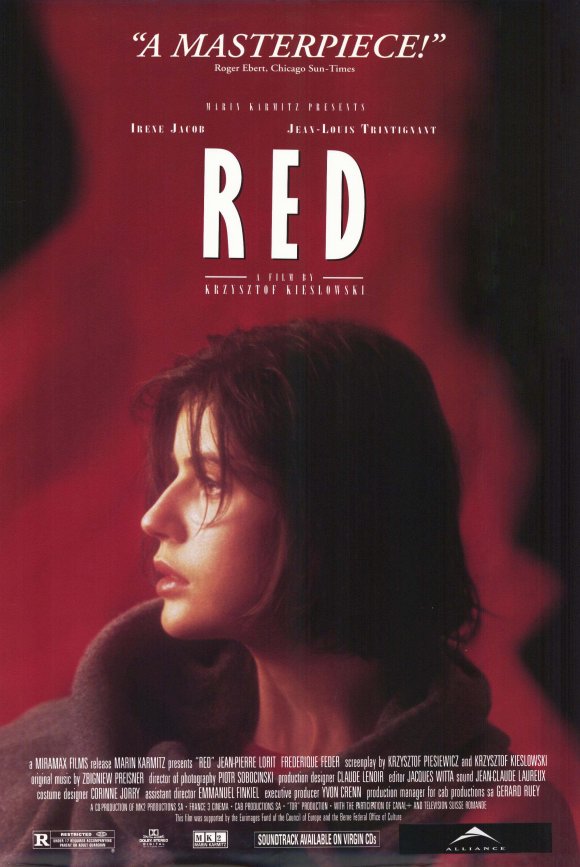
Three Colours: Red (1994) – Paths and Possibilities

As the dust settled and the cordite faded from the air, the instigators of the French revolution held aloft the severed heads of their old oppressors and proclaimed a new age of humanity; an age in which people would be governed not by the supposedly divine whim of royal genetics but by reason and the principles of the enlightenment.  Principles such as Liberty, Equality and Fraternity.  Over two hundred years later, the polish director Krzysztof Kieslowski decided to devote a trilogy of films to the question of what these hallowed values mean to the modern world.  The results are far from a glowing endorsement.

In Blue, Kieslowski renders liberty as an icy internal exile from those who would love us.  In White, he reinvents equality as a bitter and demented desire to get even. In these two films we see Kieslowski’s belief that, rather than founding a new society, the values of the enlightenment now serve to drive us apart.  Given this pessimistic assessment of the first two revolutionary values, it is surprising to discover in Three Colours: Red an exploration of the concept of Fraternity that is both upbeat in tone and resoundingly hopeful in outlook.  For Kieslowski, Liberty and Equality are virtues that drive us into the isolation of individualism while Fraternity, the sense of a common bond between all people, is the value that conspires to bring us together despite ourselves.

Continue reading →

Three Colours: White (1994) – Bitches Ain’t Shit…

There are words that yield far more easily to the lips than they do to the mind. Every day, we reach for a set of shared values and concepts which, laid down in another place and another time, no longer seem as well defined as they used to be.  Krzysztof Kieslowski’s Three Colours trilogy springs from a desire for clarification, to return to the revolutionary French values of Liberty, Equality and Fraternity and ask: What do they mean for us today?

Three Colours: White is the second film in the trilogy and its conceptual slipperiness reflects the fact that equality is one of our least understood values.  We all want to live in an equal society but do we really understand what equality entails and where in our society should the value of equality assert itself? Does a commitment to equality entail a commitment to equality of outcomes or of opportunities? Or are we talking instead about the creation of a society in which everyone is equally happy and/or equally miserable? Three Colours: White explores the dubious morality of a pursuit of emotional parity.

Continue reading →

Three Colours: Blue (1993) – Tightrope Walker

We are, according to existentialism, hopelessly free. Jean-Paul Sartre argued that, in the absence of God and the sort of meaningful meta-narratives that give life an objective meaning and purpose, we are free to define our own natures:  ‘To Do is To Be’ because ‘Existence Precedes Essence’. The problem is that freedom is a double-edged sword and while the death of God may well have done away with all limitations on our freedom, it has also served to render all of our choices meaningless.  Indeed, if all paths are open to us and equally inviting then there is no correct path to take and so every decision we do make is tainted by the knowledge that all of our choices are effectively meaningless and arbitrary.

Freedom’s double edge so concerned Sartre that he wrote a short pamphlet entitled Existentialism is a Humanism (1946) addressing the charge that existentialism is a gloomy credo.  The pamphlet ends with a barnstorming rant against Christianity:

 This is humanism, because we remind man that there is no legislator but himself; that he himself, thus abandoned, must decide for himself; also because we show that it is not by turning back upon himself, but always by seeking, beyond himself, an aim which is one of liberation or of some particular realisation, that man can realise himself as truly human (…) In this sense, existentialism is optimistic, it is a doctrine of action, and it is only by self-deception, by confusing their own despair with ours that Christians can describe us as without hope.

Barnstorming though it may be, this rant is hardly convincing as the vision of human nature that Sartre describes is one of perpetual vertigo and while ridding ourselves of the tyrannical sky-pixie is no bad thing, Sartre seems to have saddled us with another form of tyranny: The tyranny of responsibility for ourselves and the tyranny of endless choice.

This tension within the concept of freedom is beautifully demonstrated by Krzysztof Kieslowski in Three Colours: Blue, the first of a trilogy of films interrogating the values of the French Revolution (Liberte, Egalite, Fraternite).

Continue reading →

Point Blank (2010) – The Love… The Love…

From Plato to Robert Louis Stevenson and Joseph Conrad to William Golding, one of the most enduring leitmotifs in the history of Western Culture has been the duality of man and how, beneath a civilised and housebroken exterior, lurks a creature with a truly terrifying capacity for debasement, savagery and chaos. One of the reasons for the popularity of this dualistic conception of human nature is that the idea of humanity being suspended between two points allows different cultures to position the points wherever they choose. For example, for the Platonists, these points were positioned in intellectual real of the Forms and the sensual world of the flesh allowing Platonists to talk about the need for humanity to aspire to the examined life of the mind. This denigration of the body proved convenient when Plato entered the Christian bloodstream through thr works of Plotinus and Augustine allowing the life of the mind to be replaced with the life of the spirit and the pursuit of Salvation. One of the peculiarities of dualism as a cultural trope is the tendency for people to present man’s duality as an essentially moral problem with one pole representing moral rectitude and the other pole representing all that is base and horrid about human nature.  It is telling that, when Golding’s schoolboys are freed from the fetters of civilisation, they immediately turn to killing each other and not to making great art, thinking great thoughts or just fucking the living shit out of each other.  The tension between the fundamental amorality of the dualist conception of human nature and our tendency to see this duality in strictly moral terms is one that is present in many adaptations of Robert Louis Stevenson’s Strange Case of Dr. Jekyll and Mr. Hyde (1886) as for every adaptation that has presented Hyde as an evil psychopath there is an adaptation that presents him as a free spirit to whom the laws of society (for good or ill) simply do not apply. This notion that man’s inner savage need not necessarily be evil is one that is emerging as absolutely central to the films of Fred Cavaye.

Cavaye’s First film Anything for Her (2008) (a.k.a. Tout Pour Elle) tells the story of a man whose wife is sent to prison for a crime she did not commit.  Rendered incapable of functioning by the loss of his wife, the film’s mild-mannered protagonist sets about reinventing a new identity for himself that will allow him to break his wife out of prison. Events rip away the character’s veneer of bourgeois rectitude, but while the inner savage allows the character to do some genuinely terrible things, the film never passes judgement on him because what he does he does out of love and because he is ultimately in the right.

Cavaye’s second film as writer/director Point Blank (a.k.a. A Bout Portant) sees him return to this same moral hypothesis: Men and women are born divided. On the one hand, we are civilised beings who love each other, hate violence and generally follow the rules.  On the other hand, we are uncivilised beings who will stop at nothing in order to defend what we have and get what we want. Because we live in a society that protects us and enforces ‘civilised’ values, we tend to keep our uncivilised natures in check: We do not murder, we do not steal and we do not fuck the living shit out of each other at the drop of a hat. However, should civilisation fail us then our animalistic character will come to the fore.  What makes animalistic actions morally reprehensible is not their violence, their destructiveness or their anti-social character but their motivation.  In Point Blank as in Anything for Her, Cavaye believes that there is nothing that is not permissible as long as it is done out of love.

Continue reading →

The Hunter (2010) – America Unter Alles

Every morning, when I turn on the radio and hear of yet another wave of revolutionary uprisings or demonstrations in the Middle East and North Africa, I invariably think that such events are long overdue. But what causes a popular uprising? What makes such a thing overdue?

In the West, we have an ageing and apathetic population ruled over by a largely corrupt political class who have little or no interest in rocking the boat. However, though archly conservative and hugely selfish, the mindset of the political classes broadly mirrors the attitudes of the ageing population they claim to represent and so, despite the odd march and protest, a revolution is not likely to take place any time soon. However, in the Arab World, the picture is startlingly different.

In the Middle East and North Africa, a similarly corrupt, conservative and selfish political class is currently in power. However, unlike the West, the population of the Arab World is not conservative and apathetic but young, vibrant and idealistic. For a while now, the older political class has managed to keep the young in line by making lavish promises and allowing them to blow off steam by whipping up anti-US and anti-Israeli sentiment (despite their vocal outrage, Israeli atrocities have been a political godsend to the autocracies of the Arab world). When these fail to work, the ageing political classes use Western weapons and truncheons to put down the protestors while screaming about ‘foreign influence’. However, as the news reveals to us every morning, this tactic is rapidly starting to fail and the youth of the Arab World are starting to demand representation in the political classes of the countries they inhabit.

What makes this wave of uprisings feel overdue is the fact that they are largely the product of demographic weight.  The political algebra is quite clear:

Insufficient social and political mobility + high birth rate = revolution

But where does the truth of this equation come from? Where do revolutions start? Iranian director Rafi Pitts’ The Hunter suggests that, while revolutions begin with unhappy people, they seldom end that way as political issues have a tendency to outlive the people who first draw attention to them.

Continue reading →

Archipelago (2011) – Genre not as Tyrant but as Vocabulary

There are times when you wish that Ayn Rand had been a literary critic. Who else could ever hope to capture the sense of adolescent rebellion with which critics and authors alike invoke the word ‘genre’? In contemporary culture, genre boundaries seem to exist solely as things to be transgressed. But so many works now ‘redraw the boundaries of genre’ and ‘confound genre expectations’ that genre labels are effectively meaningless. They are empty suits, paper tigers and straw men that exist purely so that authors and critics can claim them to have been defeated by some new towering work of genius. Might it not be time to accept that genre has been so thoroughly transgressed, redefined and deconstructed that there is no longer any glory to be found in escaping its clutches? Might it not be time for a more grown-up attitude towards the idea of genre?

Genre is like a long-suffering parent. Endlessly forgiving and endlessly patient, it responds to its children’s professions of hatred with an affectionate pat on the head and a mug of hot chocolate to calm them down. You can scream, “I hate you! I wish you were dead!” at genre till you are blue in the face and genre will still be there when you need your next film financing or a convention circuit for your book tour. There is nothing heroic or original in transgressing genre because that is precisely what it is there for. So perhaps we should look upon genre not as some cartoon tyrant that artists can easily defeat but rather as a part of what makes up a work of fiction no different to language or lighting or pace. Joanna Hogg’s second film Archipelago displays just this attitude towards genre.

Every inch the genre film, Archipelago sees Hogg taking the basic template of French art house drama (the Victorian novel’s obsession with psychological nuance combined with the system-under-pressure psychological mechanics of psychoanalysis and the sense of perpetual loss of identity forged in existentialism) and applies it to an upper-class English family that simply cannot say how it feels or what it wants. The result is a beautifully shot, exquisitely observed and surprisingly original work of cinema that uses genre expectations not as things to be transgressed but as a means of eliciting an emotional response from the audience.


Continue reading →