REVIEW – Wings (1927)

WingsFilmJuice have my review of William A. Wellman’s Wings, the first ever film to win a Best Picture Academy Award.

Set during World War I, the film follows a pair of young men as they travel to France and earn reputations as fighter pilots. Initially antagonistic as a result of having fallen in love with the same aristocratic woman, the two men become friends until the madness of war consumes them both and one accidentally kills the other. As I explain in my review, I pretty much hated this film…

Wings is an absolutely terrible film: Despite having nearly two and a half hours in which to build characters and relationships, the writing fails to imbue the melodramatic plot with any real dramatic weight. For example, we are told that Jack and David hate each other before eventually becoming friends but nothing ever happens to either to stoke the fires of hatred or build a bridge of friendship. David never saves Jack, Jack never saves David and when Jack finally kills David it is done with absolutely zero pathos as the script fails to establish the idea that Jack might at one point have wanted to see David dead. The treatment of supporting characters is equally shoddy as a German-American airman is viciously bullied for comic effect while the women in the film are reduced to sex objects, plot devices, and guilt sponges in what the lead actress Clara Bow maintained was a misogynistic script even by the standards of 1920s Hollywood. Buttressed by inter-titles so ludicrously purple that they could have been lifted from a 1990s video game, the action scenes are surprisingly hit and miss given the vast resources thrown into producing them. Frequently little more than shots of military pilots flying in formation and pretending to crash, these scenes are a microcosm for the entire film as they are of little more than historical interest.

I think it says an awful lot about this film that its lead actress felt moved to complain about the sexism and the fact that her character was little more than a dollop of cream on top of the man-cake. However, the more I watched of this film, the more I came to realise its importance in determining which kinds of films were deserving of awards. As I explain in my review, this film was released in the same year as Metropolis and Sunrise and yet it feels almost childishly simplistic in comparison. Next time you wonder why it is that terrible films win Oscars while genuinely challenging and thought-provoking films are ignored, look no further than the crude sexism, jingoism and inflated budget of Wellman’s Wings.

Watching this film, I actually began to wonder whether one might argue that the American film industry owes as much to German emigres as its space programme – Without German scientists, there would be no Apollo; without German directors, there would be no Citizen Kane. Hmm.

Contrary to my editor’s suggestion, I gave this film an even-handed 3 out of 5 as I think the market for this Masters of Cinema release is most likely to be people with an interest in the history of American film and the unimaginative writing, poor visual story-telling and lazy bigotry of Wings actually reveal a surprising amount.

REVIEW – The Banshee Chapter (2012)

the-banshee-chapterFilmJuice have my review of Blair Erickson’s bizarrely incompetent horror movie The Banshee Chapter.

When I say “bizarrely incompetent”, I mean that while some of the set-pieces are incredibly effective and the opening vignette is incredibly eye-catching, the film has one of the most poorly-constructed narratives that I have ever encountered. People spit a lot of bile at the likes of Uwe Boll but despite making cheap, shoddy and astonishingly boring films, Boll is at least able to construct a cinematic world that makes some sort of sense.

Every style of storytelling has rules. Though some would argue that these rules are hard-wired into the human brain, a less Darwinian theory is that we are socialised into expecting certain kinds of story from certain kinds of work. Consider, for example, the way that Ruggero Deodata’s Cannibal Holocaust borrows techniques from documentary filmmaking and uses them to make his otherwise quite conventional horror film seem more terrifying. Another fine example of a work that transgresses the boundaries between genres is Stephen Volk’s Ghostwatch, which terrified Britain by using the tropes and faces of British TV to tell a fictional ghost story. Blair Erickson’s film also moves between a number of different genres and borrows from different cinematic traditions but rather than blurring the boundaries to create a particular effect, Erickson muddles the boundaries in a way that suggests he was incapable of telling the difference between them:

This is particularly glaring when Erickson continues to use found footage techniques despite the fact that the journalist is no longer keeping a video diary. It is one thing for the picture to go fuzzy and the camera to dart around in a panicky fashion when a terrified character is holding it, but why would there be interference and panicky camera movements when none of the characters are holding a camera? What is that interference supposed to represent? Erickson’s confusion of first-person and third-person perspectives on his cinematic world results in a world so broken and incoherent that it comes dangerously close to collapsing in a puddle of beautifully-edited gibberish.

Frequent visitors to this here site will doubtless have noticed that one of my most common complaints is that while a film may be beautifully made, it has absolutely nothing to say. This is undoubtedly a result of the fact that people can now go to film school, learn how to be a competent director, acquire the funds to make their own film and then realise that they have no particular message to convey or story to tell. While Auteur theory stresses the importance of vision and of having the freedom to fully realise that vision, it struggles when forced to content with neophyte directors who are still trying to find their feet. Undoubtedly a talented editor and a filmmaker with some potential, Erickson should have been reigned in by both a working script and a producer willing to ask uncomfortable questions but instead he seems to have been given free reign resulting in a film so stylistically incoherent that it is frequently impossible to tell what it is that we are supposed to be seeing.

Banshee Chapter could have been an atmospheric return to paths already well-trodden by the X-Files but instead it is an incoherent mess. While my review blames Erickson for his inability to tell a story, a more likely set of culprits are the producers who either failed to spot a foundering director or refused to throw him a life raft. Hollywood is now quite fond of marketing films on the basis of who produced them and the PR bullshit for this particular film listed Zachary Quinto’s involvement no less than three times. Based on Banshee Chapter alone, I’d say that ‘…from the dude who plays Spock in those terrible Star Trek movies’ is more of a bug than a feature.

The Sight of the Hunted: German Expressionism and Night of the Hunter

night of the hunter poster

FilmJuice have published a lengthy piece written in celebration of the recent re-release of Charles Laughton’s legendary Night of the Hunter.

This piece was a real joy as it gave me an excuse to not only rewatch the film for the first time in a while, but also to do some research into Laughton’s life and refamiliarise myself with some of the better works of German Expressionist cinema. I wrote quite a lengthy piece about German Expressionism for Videovista a few years but my understanding of that particular cinematic milieu has solidified somewhat and hooked up with some much larger thoughts I’ve been having about the relationship between psychological realism and fantasy in the psychological thriller genre. In my original Videovista article, I spoke about Expressionism in terms of:

Expressionism emerged as a reaction to impressionism. Impressionism, as practised by the artists Claude Monet and Pierre-Auguste Renoir attempted to break down the boundaries between subject and background in order to produce paintings that were almost like snapshots: images that were exacting reflections of the world itself. Expressionism reacted against impressionism by rejecting the call to represent the world ‘as it is’. Instead, expressionists favoured representations of the world that ‘expressed’ the artists’ attitudes towards the subject matter. They did not reflect the world, they abstracted from it. A key work in the development of expressionism is Edvard Munch’s painting The Scream (1893), in which the insane flowing colours of the background, the pale featureless visage of the screamer and the dark figures in the background express not merely a person screaming but rather a state of inner turmoil, paranoia, alienation and insanity.

Now I say far more straightforwardly:

The most influential work of German Expressionist cinema is undoubtedly The Cabinet of Dr. Caligari. Told entirely in flashback by a man who turns out to be an inmate in an insane asylum, Robert Wiene’s film is a hypnotic mess of light, shadow and unsettling angles. Too fantastical to be real and yet too raw to be fictitious, Caligari’s story of love, murder and sinister sleepwalkers is best understood as an emotional landscape, a realistic portrayal of what the real world feels like to the person telling the story. The light and darkness of Caligari’s world are absolute because they are absolute in the mind of the madman just as they might be in the mind of a child. This is the exact same idea that lurks behind the myriad eccentricities of Laughton’s Night of the Hunter.

Rather than seeing the film through the gauze of southern gothic, I view it as a quite explicitly psychological piece: The fantastical nature of many sequences and effects are not reflections of a world that is in itself fantastical but rather a reflection of how that world feels to the children and how children (and everyone else for that matter) use the culture they have consumed in order to make sense of the world around them. It is only natural that the world should resemble a fairy tale when the only time you have heard of evil priests and murderous ogres is in the pages of just such a children’s story. Far from being limited to the children’s worldview, Night of the Hunter occasionally switches to other worldviews such as those of the mother, a friendly drunk and a horny teenaged girl. This is a film that not only reaches back to a cinematic vocabulary that was largely unknown to 1950s American audiences, it also takes those Expressionistic techniques and takes them to the next level. Night of the Hunter is a film that is literally decades ahead of its time.

Mother

REVIEW – Winter of Discontent (2012)

Winter of DiscontentFilmJuice have my review of Ibrahim El Batout’s film about the Egyptian revolution Winter of Discontent.

Made in the immediate aftermath of the 2011 overthrow of Mubarak regime, Winter of Discontent follows a group of Egyptians as revolution changes their relationship with their government. Thus, one of the strands follows a TV presenter on a government network who is effectively forced out of her job for daring to ask awkward questions of politicians. Initially, this makes her incredibly fearful for her life but as events in Tahrir square unfold, we see her becoming increasingly bold and defiant before eventually switching sides and using Youtube to denounce the corrupt government. This story is beautifully juxtaposed with that of a secret policeman who moves from a position of absolute certainty in which he feels free to threaten and torture respectable citizens to a position where he owes his family’s safety to the forgiving nature of brutes with sticks.

Let me be clear, despite its shortcomings, I very much enjoyed Winter of Discontent and part of what made the film enjoyable was the fact that it was an incredibly middle-class film made by middle-class Egyptians about their experience of political upheaval. According to the filmmakers, this was a decidedly quiet revolution and that is something of a cinematic rarity:

Sergei Eisenstein’s immortal Battleship Potemkin begins with sailors eating maggoty food and ends with many of those exact same sailors cheering the revolution as their fellows decide to join them in open revolt against the Tsarist regime. Ken Loach’s magnificent ode to the Spanish Civil War Land and Freedom contains oodles of dead fascists and Spanish peasants finally getting a say in how to work their own fields but it ends with the granddaughter of a dead veteran giving a sad but defiant raised fist salute. These cinematic accounts of real-world revolutions may be brilliant, maudlin, triumphalist and manipulative but one thing they are not is quiet. By this measure alone, Ibrahim El Batout’s Winter of Discontent is something entirely unique: a quiet film about revolution.

Watching this film made me reflect on Western attitudes to revolution as I feel most people’s aversion to the idea of overthrowing their government stems from the fact that they are afraid of what might happen to them. This fear is perfectly captured in Marjane Sattrapi and Vincent’s Paronnaud’s Persepolis where a liberal middle-class family wind up being judged and mistreated by uneducated working class people who have been placed in positions of authority by the new regime. One of the fascinating things about Winter of Discontent is that it is entirely free from this sort of class-bound paranoia… the characters sense that something is wrong and face down brutal oppression in order to speak out but while one of the characters is a bit mistrustful of his uneducated upstairs neighbours, his feelings of solidarity quickly overwhelm any misgivings he might have had about the great unwashed. A more romantic and — dare I say it? — politically engaged director might have made a good deal more of that moment of solidarity but El Batout handles it with a quiet restraint that is actually quite refreshing.

REVIEW – Upstream Color (2013)

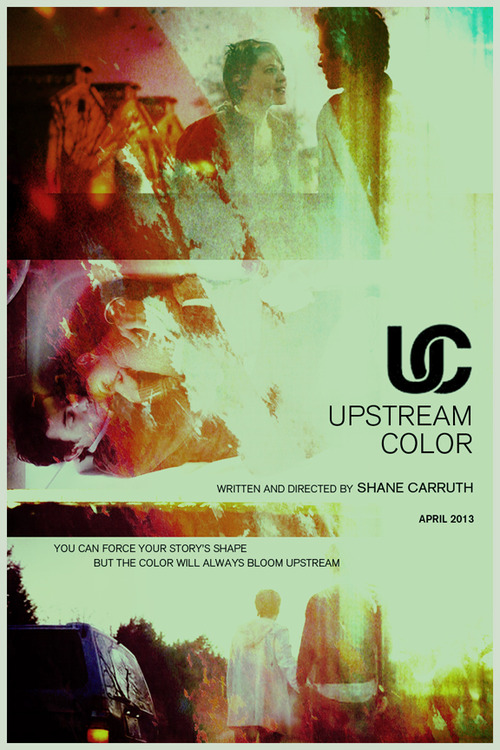
Upstream-Color-PosterFilmJuice have my review of Seth Carruth’s art house SF film Upstream Color, which came out this week on DVD and Blu-ray. I loved the film but it also made me intensely aware of the limitations of certain styles of cinematic storytelling.

At the heart of Upstream Color is a very conventional relationship movie: Two fragile people struggling to overcome life-threatening traumas meet on public transport and immediately recognise themselves in each other. Initially quite tentative, the two fragile people orbit around each other; feeling the attraction but afraid of getting too close lest they get sucked in. When the pair do eventually commit to each other they connect on such a profound level that the lines where one person stops and another person begins begin to blur. Whose memories are these? Whose emotions are these? Am I me? Are you me? Told in a way that emphasises visual storytelling over verbal exposition, Upstream Color looks and feels very much like the type of film that European art house cinema has been churning out for the last fifty years. World cinema is a very different cinematic tradition to that of Hollywood but the techniques and themes favoured by that tradition mean that Carruth can quite easily pick up their tools and tell yet another story about alienated people undergoing the ambivalent process of change associated with love and the construction of a couple’s subjectivity. This cinematic vocabulary is a mature system and Carruth is a talented-enough director to use those tools to tell a really effective if ultimately unchallenging relationship story. However, Upstream Color is a lot more besides…

Halfway through watching the film, I pointed out on Twitter that Upstream Color felt a lot like someone using an iPad to make scrambled eggs. What I meant by this was that while the core story was really quite mundane and unadventurous, Carruth tells his story using one of the richest and most complex metaphorical infrastructures in recent cinematic history. Yes, this film is all about empathy and Carruth uses an explicitly Science Fictional device to explore how empathy can open us up to good as well as bad experiences, Carruth’s device is actually a lot more complex than a traditional relationship drama would require. Indeed, while Buffy the Vampire Slayer trod similar ground by making Buffy temporarily telepathic, Carruth cracks the egg of human relationships with the genre equivalent of a sledgehammer. A worm that, when consumed, puts people in state of such psychological vulnerability that someone can effectively clean out their bank account, destroy their life and order them to forget the whole thing. Even more conceptually lavish, Carruth explores the life-cycle of these worms and how, once removed from a human host, they allow people who understand the technology to ‘check in’ and watch the people that were once infected. Frankly, there are enough ideas and story-hooks in these worms to support and entire film festival but Carruth only really begins to exploit the thematic potential of his device at the end of the film:

Aware that his genre tropes can probably handle a lot more than a simple relationship story, Carruth devotes the final act to pushing the limits of his metaphorical infrastructure and so we are treated to an absolutely beautiful sequence in which the life-cycle of the worms is revealed and a further sequence in which Jeff and Kris confront their shared trauma and tentatively begin edging towards a less isolated way of living. Carruth handles both of these expansions quite well but the combination of oblique storytelling techniques and limited space means that much of their thematic and dramatic potential must remain untapped. Indeed, Terrence Malick’s The Tree of Life spends over two hours wrestling with ideas far less substantial than the ones that Carruth rushes through in less than ten minutes!

In an age when both art house and mainstream directors are making films based on tired and insubstantial ideas, it is both refreshing and slightly overwhelming to encounter a film that could easily have been a trilogy or a series. Upstream Color is not just an incredibly beautiful and well-told story, it is a film so full of ideas and thematic resonances that it is almost too frustrating to watch. Sitting through Upstream Color I was struck by the extent to which art house cinematic techniques struggle to convey new types of information. Watch enough art house films about alienated people trying to get their lives back on track and those techniques are incredibly effective at conveying mood and theme but ask those techniques to explore the psychic fallout of discovering that you are only one of hundreds of people who have been secretly observed by shadowy figures and those techniques begin to struggle. Upstream Color could have been about the NSA and Google dismantling privacy, it could have been about post-traumatic stress or it could have been about the psychic fallout from being involved in a mass event like a terrorist atrocity or a religious cult. It could have been about any of these things and yet the film ended too soon.